Best Resistance Bands for Seniors: A Safe Buying Guide
After 45, muscle naturally declines — a process called sarcopenia — making stairs, groceries, and getting up from a chair harder and riskier. Resistance bands are one of the simplest tools to push back: light, inexpensive, joint-friendly, and they fit in a drawer.
But not all bands are created equal. The wrong type or too much resistance can lead to strain or a snapping band. This guide explains the band types, how to pick the right resistance level, the safety rules that matter most after 60, five beginner moves, and what recent research actually says about their effectiveness.
Why Resistance Bands Suit Adults Over 45
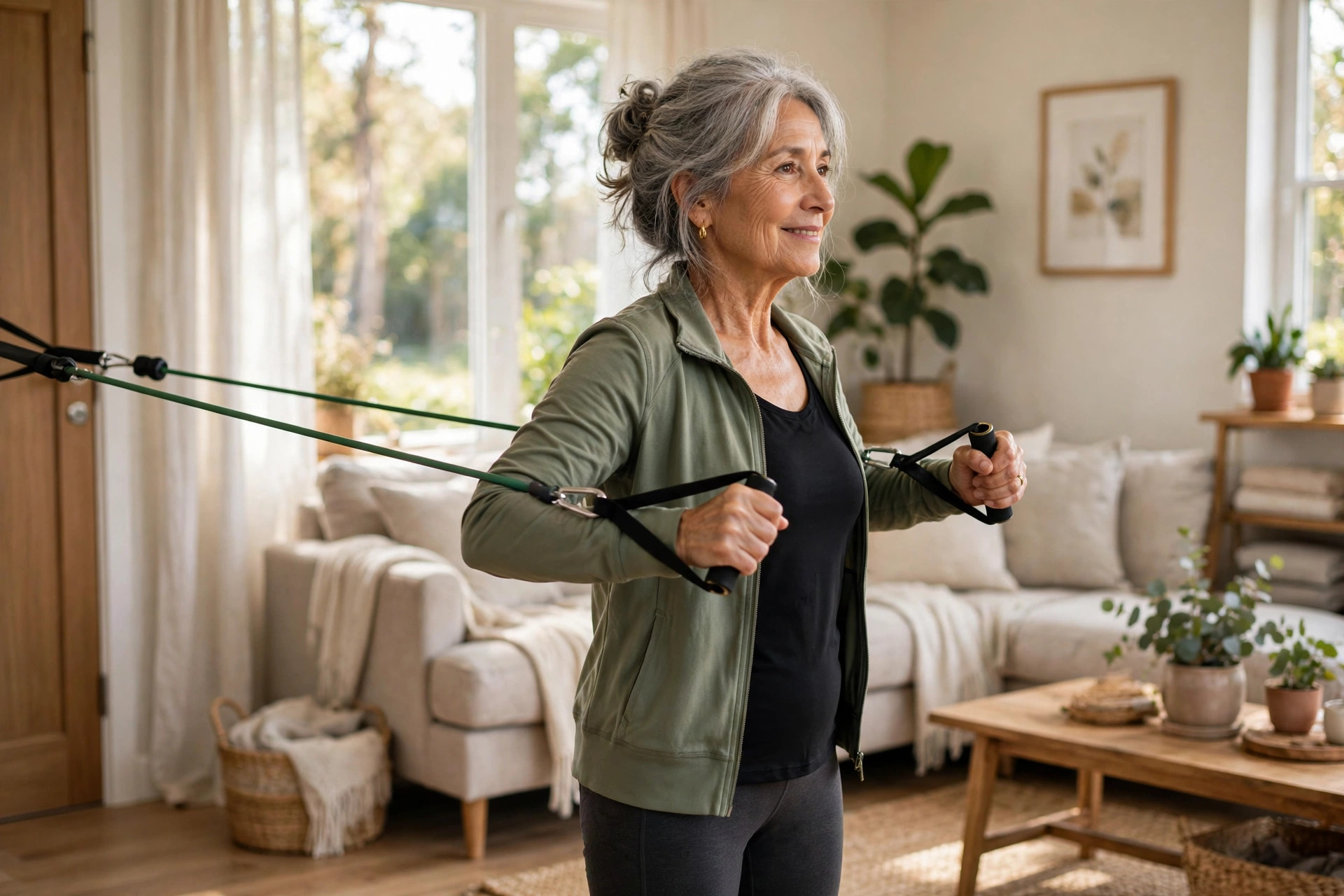
Resistance bands create tension when you stretch them, challenging your muscles through the entire movement — both the pull and the slow release. That constant tension helps build functional strength: the strength you use to stand up, reach overhead, and stay steady on your feet.
Bands have several practical advantages:
- Low impact. No heavy weight to drop or momentum to control, which is easier on joints than free weights.
- Adjustable on the fly. Grip the band closer to or farther from its end, or switch to a lighter or heavier band.
- Portable and affordable. A full set costs less than a month of most gym memberships and weighs almost nothing — practical for travel or small apartments.
- Seated options. Many exercises work from a sturdy chair, which suits people with balance concerns or sore knees.
Band Types Explained: Loop, Flat, Tube, and Figure-8
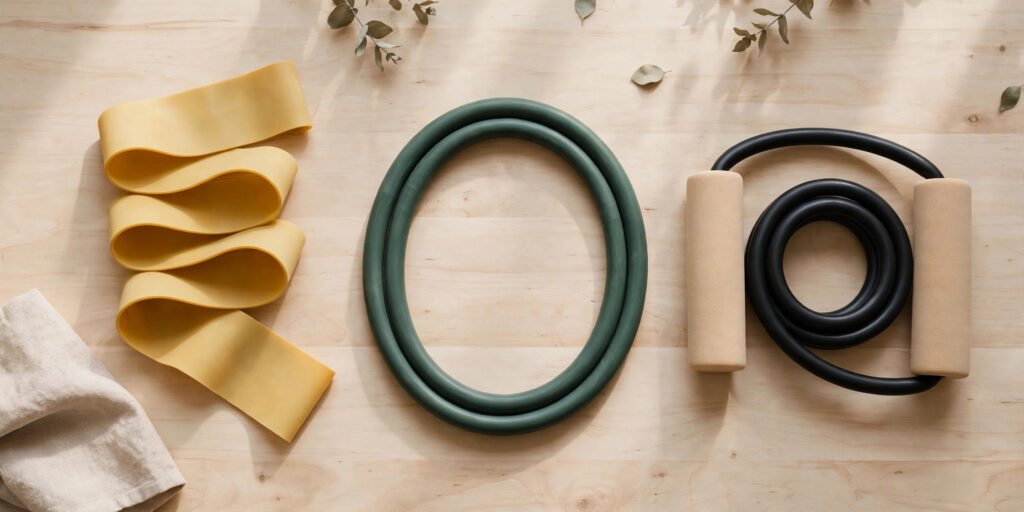
There are four common styles, and each suits different exercises. No particular brand has been shown superior — what matters is the type, the resistance level, and the quality of the material.
Flat therapy-style bands. These are long, flat strips of rubber, often sold in graded resistance levels indicated by color. They are the type physical therapists commonly use for rehabilitation. Flat bands are very light to start with, easy to tie to furniture or wrap around the hands, and they fold up to almost nothing. Their main drawback is the grip: wrapping a flat band around sore or arthritic hands can be awkward.
Tube bands with handles. Hollow rubber tubes with a foam or plastic handle at each end, often sold as stackable sets with a door anchor and ankle straps. The handles are easier to grip — many older adults prefer them — and they are excellent for rows and chest presses. Inspect the connection points regularly, since that is where wear shows first.
Loop bands (closed circles). Continuous circles of rubber, from slim mini loops (placed above the knees for hip and balance work) to wide long loops (used for squats). Mini loops are especially useful for seniors: they strengthen the hip muscles that keep you upright and reduce fall risk. Wide long loops are usually too heavy for beginners over 60.
Figure-8 bands. Shaped like the number 8 with a handle in each loop, these are compact and simple: mostly used for chest flies, rows, and shoulder work. They are easy to use but less versatile than the other types.
How to Pick the Right Resistance Level
Bands are sold by resistance, but there is no universal standard: one maker’s “light” may be another maker’s “medium.” Choose sets that list approximate tension in pounds or kilograms, and start lighter than you think you need.
A sensible rule for adults over 55 starting out:
- Upper-body work (curls, rows, presses): start at roughly 5–15 lb of tension.
- Lower-body and hip work (mini-loop abductions, leg presses): start at roughly 10–25 lb, since leg muscles are larger.
- You should be able to complete 10–12 repetitions with good form, feeling the effort in the last two or three reps. If you cannot finish a set without straining, the band is too heavy.
Buy a set with multiple levels rather than a single band: legs need far more resistance than shoulders, and no single band covers both. A set also lets you progress: when 12 repetitions become easy, move to the next level up instead of buying new equipment. That gradual increase — progressive overload — is what research suggests drives results.
Features That Matter: Handles, Anchors, Durability, Latex vs. Fabric
Handles vs. no handles. Handles are easier on arthritic hands and give a more secure grip for pressing and pulling. Flat bands are lighter and more versatile for rehab-style work.
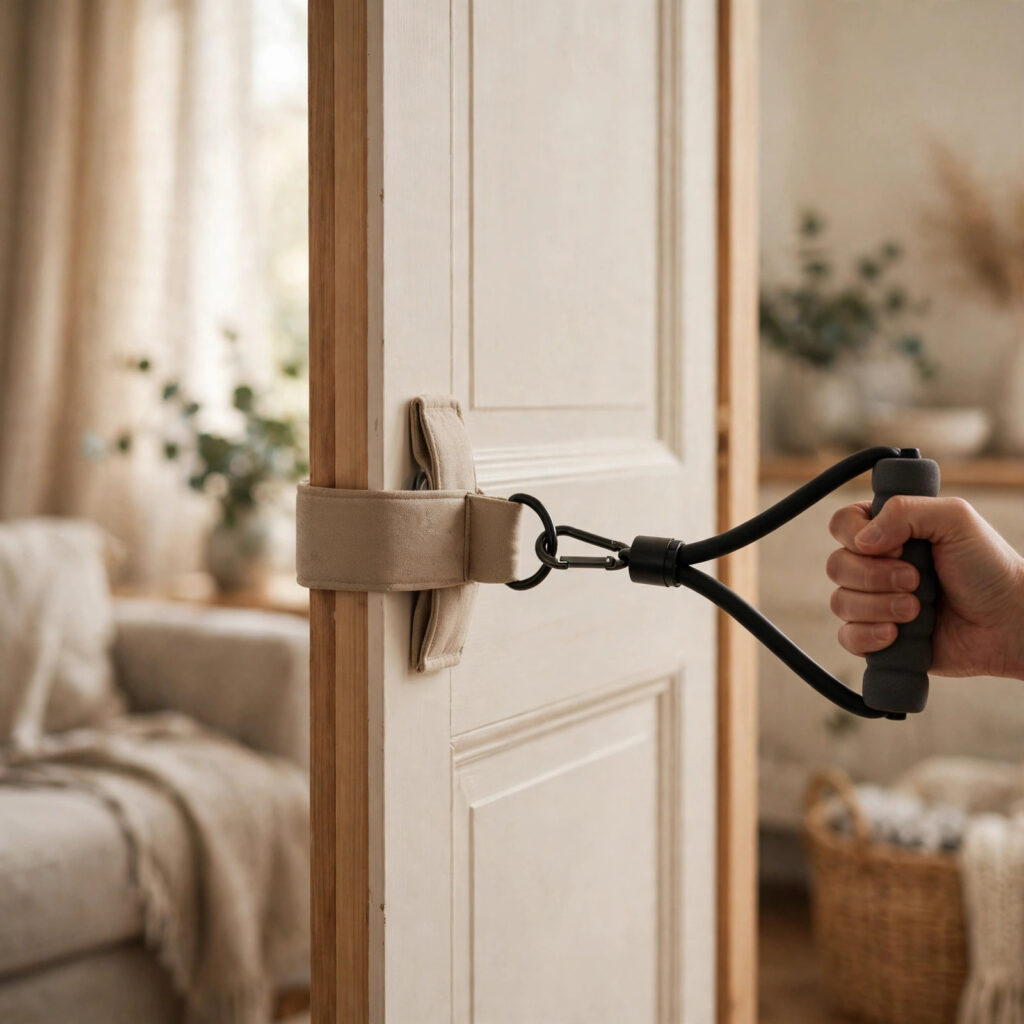
Anchors and straps. Tube sets often include a fabric door anchor — wedged behind a closed door — and ankle straps. Use only a solid interior door that closes firmly, and check the anchor before every session.
Durability and construction. Latex (natural rubber) bands stretch smoothly and usually cost less. Fabric-covered loops resist rolling up the legs and pinching skin, which many people prefer for lower-body work. Some tube sets include an inner safety cord: if the rubber fails, the cord catches it instead of letting the band snap back. Whatever you choose, replace any band with nicks, tears, or weakened spots — inspect before every session.
Latex vs. latex-free. If you have a latex allergy, choose bands sold explicitly as latex-free. Many fabric-covered loops still contain latex threads, so “fabric” alone does not guarantee a band is latex-free — read the product description.
Storage. Bands last longer when kept cool, dry, and out of direct sunlight. Heat, sun, and rough surfaces break rubber down faster. Roll or fold them loosely, store them in a bag or drawer, and keep them away from sharp objects.
Beginner Safety Rules
- Inspect every band before each use. Look for small tears, nicks, or thin spots, especially near handles. Discard a damaged band.
- Start with the lightest resistance. You can always move up; starting too heavy risks strain or a torn band.
- Never stretch a band toward your face or release it while under tension. Return to the starting position slowly and under control.
- Anchor securely. Test the door anchor with a firm pull before your first rep, using a solid door that closes firmly.
- Sit if you need to. Many exercises work just as well from a sturdy chair with no wheels.
- Breathe steadily. Exhale on the effort (the pull), inhale on the return. Never hold your breath and strain — that can spike blood pressure.
- Stop if something hurts. Mild muscle fatigue is normal; sharp joint pain, dizziness, or chest discomfort are not.
5 Simple Starter Moves
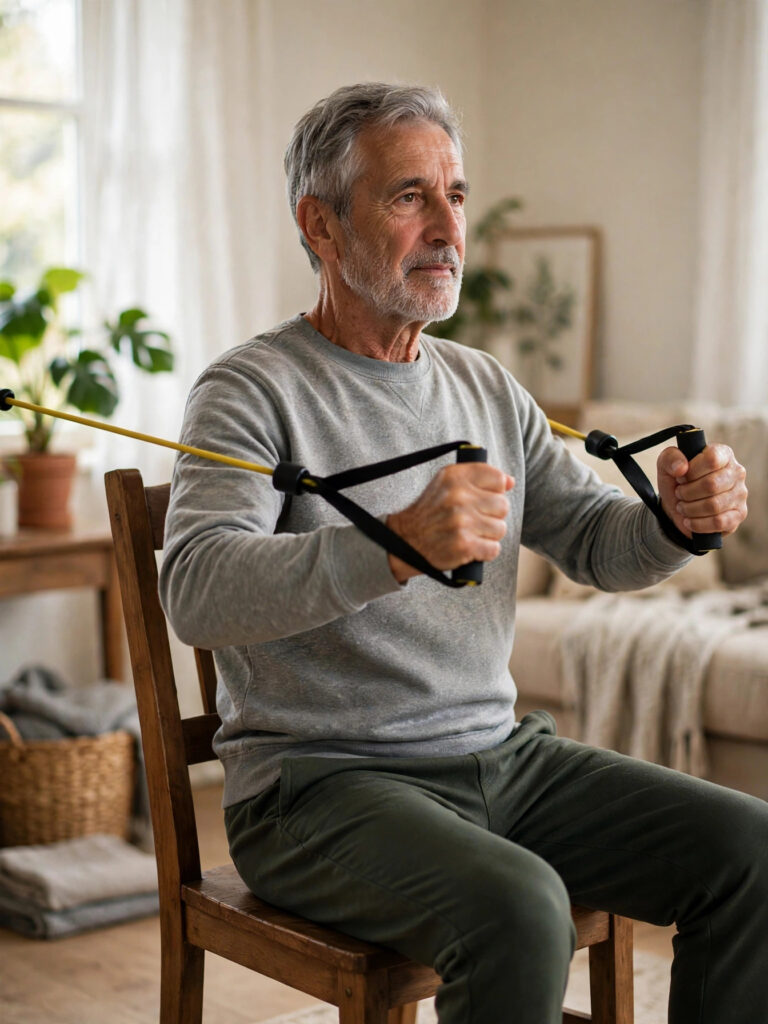
Do these 2–3 times per week, with at least one rest day between sessions. Start with 1 set of 10 repetitions each, and add a set per week as it gets easier.
1. Seated row. Sit tall in a sturdy chair, band looped under your feet or secured ahead of you. Pull toward your lower ribs, squeezing your shoulder blades together, then release slowly. Works the upper back and posture muscles.
2. Standing chest press. Band anchored behind you at chest height on a closed door; step forward until taut and press both hands forward to full extension. Works chest, shoulders, and arms.
3. Mini-loop hip abduction. Mini loop just above your knees, holding a chair back for support. Press knees outward against the band, hold one second, return. Strengthens the hip muscles that protect balance.
4. Standing biceps curl. Stand on the band’s center and curl the handles toward your shoulders, elbows tucked. Lower slowly. Works the front of the upper arms.
5. Standing side raise. Arms at your sides, raise both arms out to shoulder height and lower slowly. Use the lightest band — shoulders respond to small loads.
Does the Evidence Support Bands? What Recent Research Says
Short answer: yes, with honest caveats.
A 2026 systematic review (PMID 41812594) pooled four randomized controlled trials covering 148 frail adults aged 65+ who trained with elastic bands for 12–28 weeks. Results showed significant improvements in overall functionality, handgrip strength, and lower-limb strength — strongest with progressive intensity and longer programs. The authors called elastic bands “a safe, affordable, and feasible intervention” for frail older adults. That is the modality with evidence: elastic bands as a category, not any particular brand or design.
A 2026 meta-analysis of 13 randomized trials with 546 older adults living with sarcopenia found that resistance exercise produced meaningful improvements in grip strength, gait speed, appendicular muscle mass, and sit-to-stand performance, with about three sessions per week showing strong effect sizes — consistent with CDC and National Institute on Aging guidance of muscle-strengthening activity at least two days per week.
The honest caveats matter too. The frailty review judged three of its four trials at high risk of bias — mainly weak randomization reporting and missing data — so the headline results should be read with some caution. And no review proves that any particular brand or band type is superior: the evidence supports elastic-band training as a method. Claims that one design “works better” than another are marketing, not science.
What this means for you: the research supports using resistance bands regularly with gradually increasing difficulty. It does not support paying extra for a band that promises faster or better results.
Storage and Care
Keep bands cool, dry, and out of direct sunlight — heat and sun degrade rubber quickly. Wipe latex bands with a damp cloth after use, air-dry, and store loosely coiled away from sharp objects. The rule is condition, not calendar — inspect before each session and retire any damaged band.
When to See a Doctor
Talk to your clinician before starting if any of these apply:
- You have a heart condition, uncontrolled high blood pressure, or angina.
- You have had a recent surgery, fracture, or joint replacement.
- You have severe osteoporosis, advanced arthritis, or chronic balance problems.
- You experience chest pain, unusual shortness of breath, or dizziness during exercise.
- You are currently in physical therapy — ask your therapist which band type and resistance level fits your program.
Stop exercising and seek medical advice if you develop sharp joint pain, chest discomfort, severe dizziness, or numbness in a limb during or after a workout.
Sources
- National Institute on Aging (NIH) — “How Can Strength Training Build Healthier Bodies as We Age?” — nia.nih.gov
- CDC — “Strength Training: Get Stronger, Leaner, Healthier” (Physical Activity Guidelines) — cdc.gov
- Mayo Clinic — “Strength training: Get stronger, leaner, healthier” — mayoclinic.org
- NHS — “Strength exercises” — nhs.uk
- Systematic review (2026), Rehabilitación (Madr) 60(1):100961 — elastic-band training in frail older adults (4 RCTs, n=148) — pubmed.ncbi.nlm.nih.gov/41812594 — DOI: 10.1016/j.rh.2026.100961 — PROSPERO: CRD42024582352
- 2026 meta-analysis of 13 RCTs on resistance exercise in older adults with sarcopenia (n=546) — secondary summary: karmactive.com
This article is for informational purposes only and is not medical advice. Talk to your clinician before starting a new exercise program.