
Knee Pain After 60: Causes, Relief, and When to See a Doctor
The stairs feel steeper than they used to. Getting up from a low chair takes a little planning, and the first few steps in the morning are stiff enough that you notice them. If that sounds familiar, you are in good company: knee trouble is one of the most common physical complaints adults report after 60.
The reassuring news is that most knee pain in older adults comes from a short list of well-understood causes — and most can be managed without surgery. This guide covers the common culprits, the everyday strategies that help, safe exercises to protect your knees, and the warning signs that mean it is time to see a doctor.
Why knees complain more after 60
Your knee is a hard-working joint. Every step sends force through it, and over decades the parts that absorb that force gradually change. Cartilage — the smooth tissue that lets the joint glide — thins with wear, supporting muscles can weaken, and tendons and ligaments become less flexible.
None of this is a personal failure — these mechanical, age-related changes explain why knee problems are so widespread after 60. The National Institute on Aging notes that the knees are among the joints most commonly affected by osteoarthritis, and that its symptoms can make it hard to walk, climb stairs, and get in and out of chairs.
The most common causes of knee pain after 60
Osteoarthritis: the wear-and-tear arthritis
Osteoarthritis is by far the most common cause of knee pain after 60. It happens when the cartilage inside the joint gradually breaks down, so the bones begin to rub together more than they should, creating friction, inflammation, and stiffness. Cleveland Clinic describes knee osteoarthritis as a long-term, progressive condition — it cannot be undone, but it can be managed well, and lifestyle changes may help slow its progress.
Typical signs include pain that is worse with activity and eases with rest, stiffness after sitting or sleeping, swelling around the joint, a grinding or crunching sensation when bending the knee, and pain that makes stairs, squatting, or long walks harder.
Meniscus wear and small tears
The menisci are two wedge-shaped pieces of cartilage that act as shock absorbers between your thigh bone and shin bone. In younger people they usually tear during sports, but after 60 they can fray gradually from years of ordinary use. Mayo Clinic notes that about half of people over 50 have a meniscus tear — and minor tears may cause no symptoms at all.
When a wear-related tear does cause trouble, signs can include a popping sensation, swelling, pain when twisting the knee, or difficulty fully straightening the leg. Because osteoarthritis and meniscus tears often occur together, a physical examination — and sometimes imaging — can help sort out which is driving the symptoms.
Bursitis
Around the knee sit small fluid-filled sacs called bursae, which cushion the areas where tendons and skin rub against bone. When a bursa becomes irritated — from repeated kneeling, a direct bump, or overuse — the knee can feel warm, swollen, and tender, with pain that worsens when you kneel or bend the joint. Rest and activity changes usually calm it down.
Tendonitis
Tendons — the cords attaching muscle to bone — become less flexible with age. Knee tendonitis, often the tendon just below the kneecap, typically causes pain beneath it that worsens with stairs, squatting, or long sitting. Treatment usually means easing off the aggravating activity, gentle stretching, and strengthening the surrounding muscles.
Other possibilities
Knee pain is not always a “wear” problem. Inflammatory conditions such as rheumatoid arthritis and gout can also affect the knee — Mayo Clinic lists both among the medical causes of knee pain — and sometimes knee pain is referred from another joint entirely, such as a troubled hip. For more on the broader picture, see Joint Pain After 50: Causes, Relief, and When to See a Doctor.
What helps: everyday strategies for knee pain relief

There is no single fix, but a combination of small, steady steps can make a real difference.
Keep moving — but choose low-impact activity. Complete rest often makes things worse: gentle movement keeps the supporting muscles strong and loosens stiffness. Mayo Clinic recommends switching to low-impact movement — swimming instead of jogging — and Cleveland Clinic lists swimming, water aerobics, yoga, short walks, and low-impact strength training as good options for knee osteoarthritis.
Strengthen the muscles that protect the knee. Strong quadriceps and hamstrings act as shock absorbers for the joint. Research has linked quadriceps weakness with knee pain, and strengthening these muscles is one of the best forms of prevention and management. Simple exercises such as straight-leg raises are a good starting point.
Keep your weight in a healthy range. Extra body weight increases the load the knee must carry with every step. Mayo Clinic’s self-care page notes that weight loss, when needed, lightens the pressure on the knee. Even modest, gradual weight loss may help reduce symptoms.
Use heat and cold wisely. As a general rule: cold suits a new, swollen flare-up; warmth suits stiffness and chronic aching. The NHS advises applying an ice pack (or a bag of frozen peas wrapped in a tea towel) to the knee for up to 20 minutes every 2 to 3 hours during a flare-up. For morning stiffness, a warm shower or heating pad before activity may help loosen the joint.
Try over-the-counter options carefully. Nonprescription pain relievers, including acetaminophen and topical anti-inflammatory gels, may help — Mayo Clinic notes that acetaminophen may ease arthritis pain in some people, and topical gels act locally on the knee. After 60, oral anti-inflammatory pills carry more risk for the stomach, kidneys, and blood pressure, so ask your doctor or pharmacist about the safest choice and dose for you.
Support the joint from the outside. A simple knee sleeve, more supportive shoes, or a cane or walking stick during flare-ups can take pressure off a sore knee. Braces, shoe inserts, and walking aids are among the options that may help (Cleveland Clinic), and a physical therapist can identify muscle weaknesses and tailor exercises to your knees.
Safe exercises for knees after 60
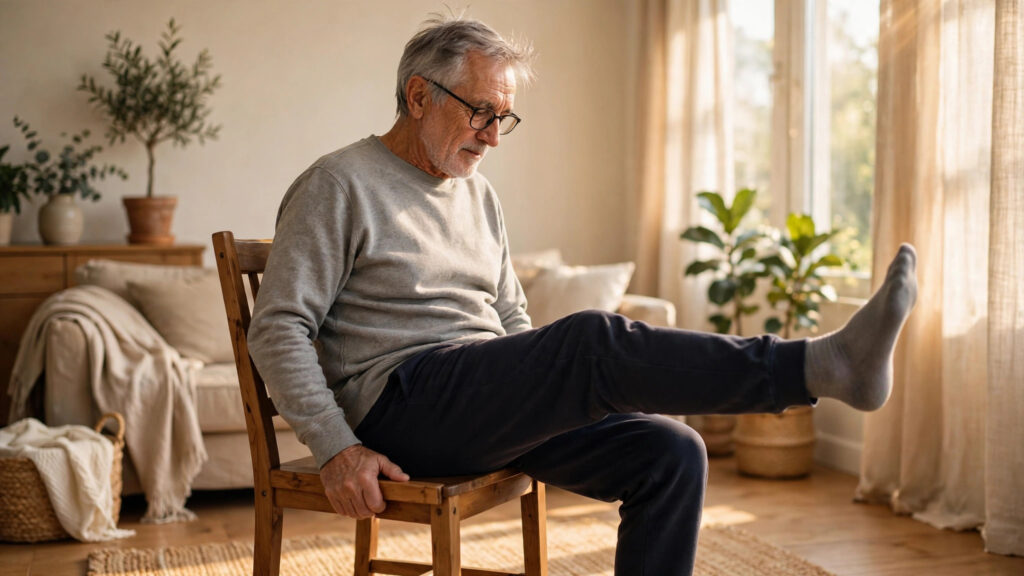
Exercise is medicine for achy knees — but the type matters. Aim for activities that build strength and keep you moving without pounding the joint. Start gently, stop if you feel sharp or increasing pain, and build up gradually.
Walking. A flat, even surface at a comfortable pace is one of the simplest joint-friendly exercises. Build up slowly, and use a cane or walking poles if your knee feels unsteady. See Is Walking Good for Arthritis? How Much Is Enough for practical guidance on distance and pace.
Swimming and water aerobics. Water supports your body weight, which means you can strengthen the leg muscles with very little joint stress.
Stationary cycling. A gentle ride with low resistance keeps the knee bending and the quadriceps working, with almost no impact.
Straight-leg raises. Lie on your back with one knee bent, foot flat on the floor. Tighten the thigh muscle of the straight leg, lift the heel about 15 centimeters, hold briefly, then lower slowly. Repeat 8–10 times per side. This strengthens the quadriceps without bending the knee.
Seated knee extensions. Sit tall and slowly straighten one knee as far as comfortable, squeeze the thigh briefly, then lower. Repeat 8–10 times per leg.
For a fuller routine, see 7 Low-Impact Exercises for Bad Knees.
What to avoid. Deep squats, kneeling on hard surfaces, high-impact running or jumping, and twisting on a bent knee tend to aggravate knee problems. Also skip the “no pain, no gain” mindset: mild muscle effort is fine, but sharp pain is your body’s signal to stop and reassess.
When to see a doctor
Most knee pain responds to the steps above within a few weeks. See a doctor if:
- Knee pain that doesn’t improve within a few weeks of self-care, or keeps getting worse (NHS)
- You cannot bear weight on the knee, or the knee feels unstable or gives way (Mayo Clinic)
- The knee is markedly swollen or has changed shape (Mayo Clinic; NHS)
- You cannot fully straighten or bend the knee (Mayo Clinic)
- The knee locks, painfully clicks, or catches (NHS)
- You have a fever along with redness, pain, and swelling — this can signal a joint infection and needs same-day attention (Mayo Clinic; NHS)
- Obvious deformity, or severe pain after an injury (Mayo Clinic)
A clinician can confirm the cause with a physical exam and, when needed, imaging, then tailor treatment — which may include physical therapy, injections, or for advanced arthritis a discussion about knee replacement. Note what makes your pain better or worse; it makes the appointment far more useful.
The bottom line

Knee pain after 60 is usually a mechanical, manageable problem — most often osteoarthritis or wear-related meniscus damage — not a sign that your knees are “done.” The pillars of relief are consistent across the clinical guidelines: stay active with low-impact movement, strengthen the muscles around the knee, keep weight in a healthy range, use heat and cold appropriately, and seek care when the warning signs appear. And if your knees are also stiff in the morning, you may find Morning Stiffness: Why Your Joints Ache When You Wake Up helpful too.
Sources
- National Institute on Aging (NIH) — Osteoarthritis: symptoms (stiffness, swelling, pain making it hard to walk, climb, and get in and out of chairs), knees among the most commonly affected joints. https://nia.nih.gov/health/osteoarthritis/osteoarthritis
- Mayo Clinic — Knee pain: Symptoms and causes: causes of knee pain (injuries, arthritis including osteoarthritis, rheumatoid arthritis and gout); when to see a doctor (can’t bear weight, marked swelling, can’t fully extend or flex, deformity, fever with redness/pain/swelling, severe pain after injury). http://www.mayoclinic.org/diseases-conditions/knee-pain/symptoms-causes/syc-20350849?p=1
- Mayo Clinic News Network — Q&A: Evaluation can determine cause, guide treatment for knee pain: about half of people over 50 have a meniscus tear; minor tears may cause no symptoms; nonoperative treatment first. https://newsnetwork.mayoclinic.org/discussion/mayo-clinic-q-and-a-evaluation-can-determine-cause-guide-treatment-for-knee-pain/
- Mayo Clinic — Knee pain: Self-care resources: switch to low-impact movement; weight loss lightens pressure on the knee; ice, compression, elevation; nonprescription pain relievers. https://www.mayoclinic.org/symptoms/knee-pain/resources/sym-20050688?p=1
- Cleveland Clinic — Knee Osteoarthritis: Symptoms, Stages, Causes & Treatment: cartilage breakdown causing pain and stiffness; exercise (swimming, water aerobics, yoga, short walks, low-impact strength training), weight control, hot/cold therapy, supportive devices. http://my.clevelandclinic.org/health/diseases/21750-osteoarthritis-knee
- NHS (UK) — Knee pain: ease knee pain at home (ice up to 20 minutes every 2–3 hours, painkillers); see a GP if pain doesn’t improve within a few weeks; urgent signs (can’t bear weight, badly swollen or changed shape, locks or gives way, fever with redness/heat). https://www.nhs.uk/symptoms/knee-pain/
This article is for informational purposes only and is not medical advice. Talk to your clinician before making changes to your health routine.