Best Rice Cookers for Seniors: Simple, Safe, One-Button Cooking
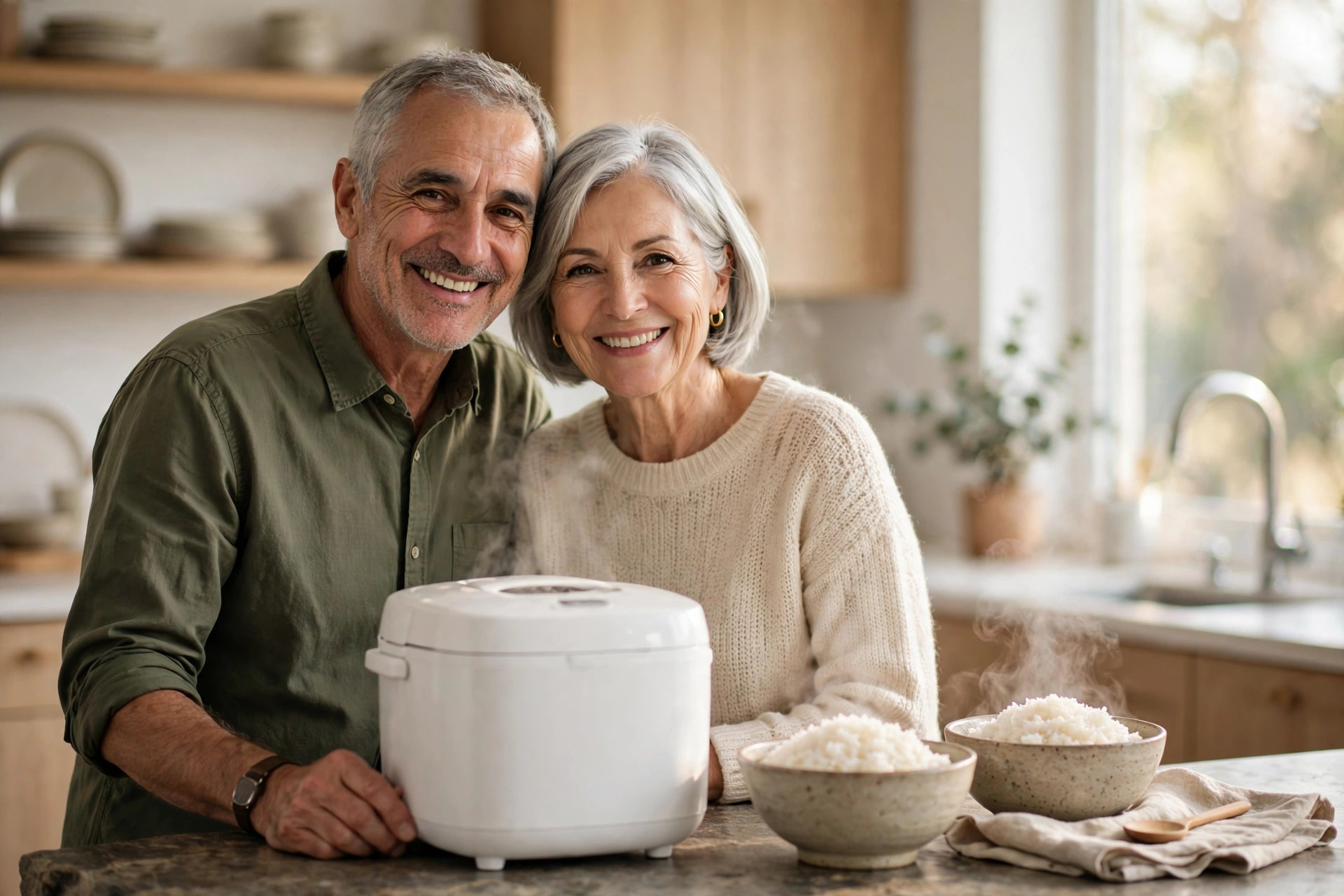
A pot of rice sounds simple — until you are standing over a stove, watching the water, trying to keep it from boiling over or burning. A rice cooker takes that job off your hands: measure the rice and water, press one button, and walk away. When the rice is done, the cooker switches itself to keep-warm. This guide covers the main types, what to check, and how to use one safely.
Why a rice cooker helps after 60
Cooking rice on the stove asks more of you than it seems: lifting a heavy pot of water, watching a rolling boil, lowering the heat at just the right moment, then lifting a hot lid. A rice cooker removes most of that — no open flame or boiling pot to watch — and it senses when the water is absorbed and switches itself to keep-warm, for consistent results every time.
Arthritis is one reason stove-top cooking gets harder. According to the U.S. Centers for Disease Control and Prevention, about 1 in 4 American adults — an estimated 58.5 million people in 2016–2018 — has doctor-diagnosed arthritis, and about 4 in 10 of them say it limits their usual activities. Stiff, sore finger joints make gripping a heavy pot handle harder, and lifting a pot of boiling water with a weak grip is a burn risk. A rice cooker with a light, removable inner pot and a single large switch asks far less of your hands, and lets you sit down while it works. For more arthritis-friendly kitchen tools, see our ergonomic kitchen tools buying guide.
The main types of rice cookers
1. One-button basic cookers
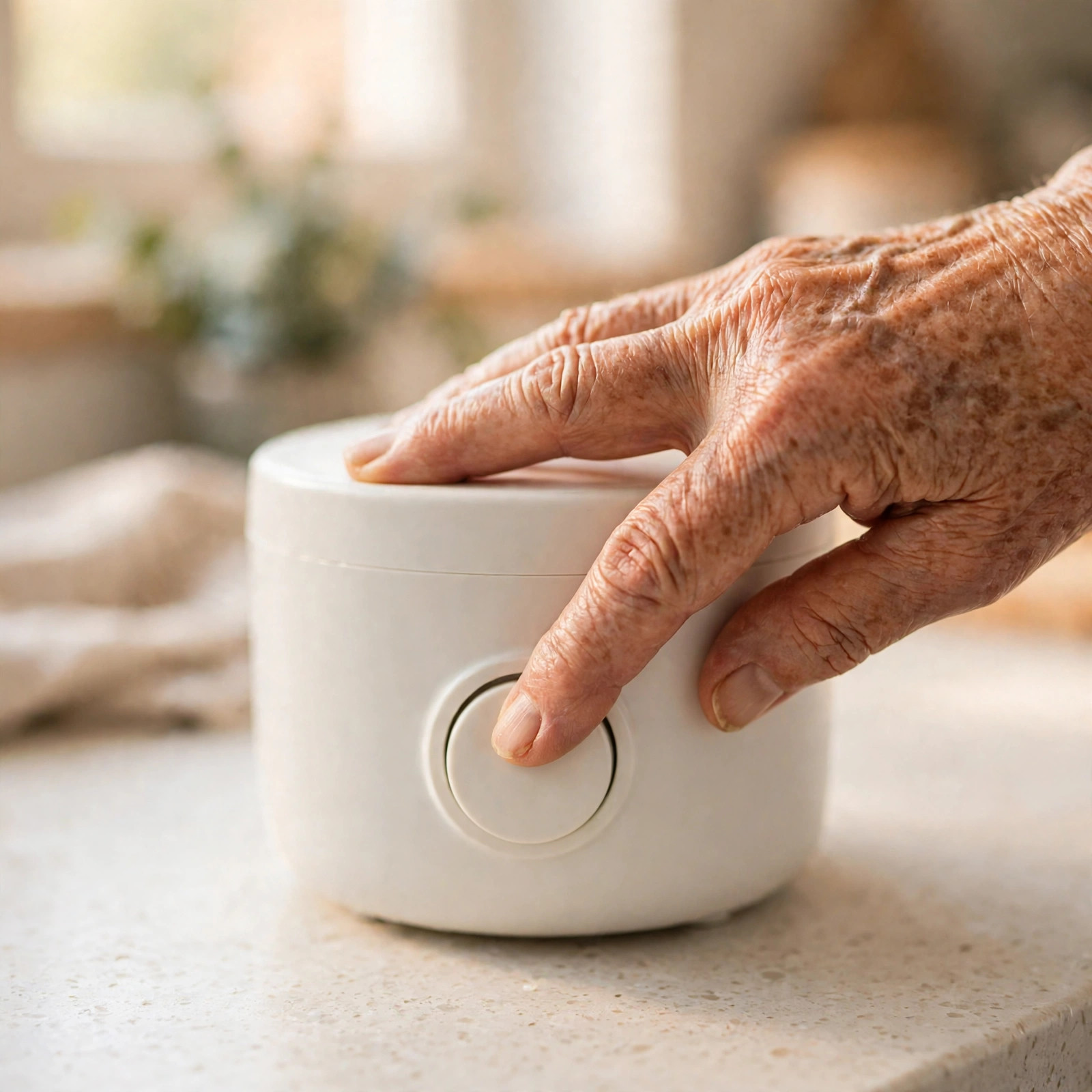
The simplest type, and often the best choice for seniors. Add rice and water, press one switch, and the cooker heats until the water is gone, then flips itself to keep-warm. No menus, no display, nothing to program. These are usually the lightest and cheapest cookers, and they handle white rice, brown rice, and steamed vegetables well. The limits: fixed cooking times, no delay timer, and brown rice may come out firmer than you like.
2. Fuzzy-logic and micom cookers
These use a small computer chip to sense temperature and adjust the heat as the rice cooks. Many offer separate settings for white rice, brown rice, porridge, and steaming, plus a delay timer. Results can be more even, especially for brown rice and mixed grains. The trade-off is complexity: a small display, several buttons, and a short learning curve.
3. Induction heating (IH) cookers
Induction models heat the whole inner pot evenly using magnetic induction, rather than a single heating plate underneath. They offer very even cooking and precise temperature control, and they are often the most expensive type on the shelf. For most households of one or two, the difference in the finished rice is modest.
4. Mini 3-cup vs family-size cookers
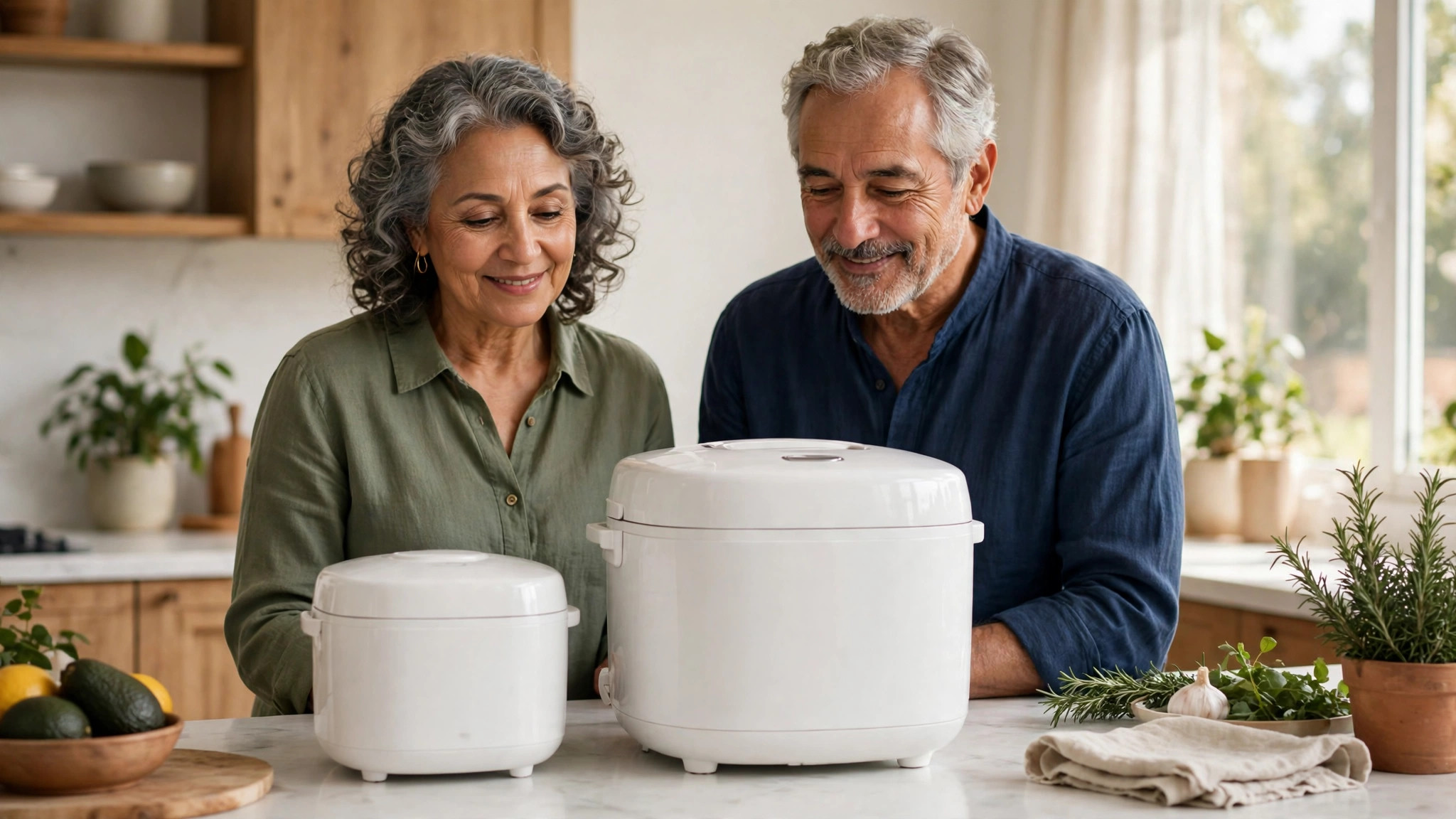
Size is measured in cups of uncooked rice; one cup uncooked makes roughly two cups cooked. A mini 3-cup cooker makes enough for one or two people with a little left over, and it is light, compact, and easy to store. A 5- or 6-cup cooker suits a couple who likes leftovers. For most senior households, a 3- to 5-cup cooker is the sweet spot: big enough for dinner and tomorrow’s lunch, small enough to lift easily.
What to look for before you buy
- Size for one or two people. A 3- to 5-cup cooker is usually right. Check whether the stated capacity is uncooked or cooked cups — makers differ.
- Keep-warm safety and auto shut-off. Look for a cooker that switches to keep-warm on its own and has an automatic shut-off, so the rice cannot burn if you forget it.
- Easy-clean nonstick inner pot. A removable nonstick inner pot wipes clean in seconds and lifts out for washing at the sink. Check that the pot has a rim you can grip comfortably.
- Large, clear buttons and markings. On a one-button model, the switch should be big and easy to press. On a digital model, look for large print and high contrast you can read without glasses.
- Lightweight pot and body. A full pot of cooked rice is heavier than the empty cooker, so lift it the way you would at home.
- Steam vent safety. Steam escapes from a vent in the lid, and it is hot enough to burn. Look for a vent away from where your hand rests, and a lid that opens away from you.
- Cord length. A short cord is safer on a crowded counter — it cannot snag or pull the cooker off the edge — but it must still reach your outlet. A detachable cord is easier to store.
If you already use a slow cooker for one-pot meals, a rice cooker is a natural companion — our slow cooker buying guide for seniors covers that side of the kitchen.
Safety tips for older cooks
- Keep hands and face away from the steam vent. Open the lid away from you and let the first burst of steam escape before leaning in.
- Place it on a stable, flat counter. Keep it away from the edge, on a surface that will not wobble — never on a stove top or near a sink.
- Unplug it when you are done. Once the rice is served and the cooker has cooled, unplug it.
- Let the pot cool before washing. A hot nonstick pot under cold water can warp over time. Let it cool a few minutes, then wash with a soft sponge — never a scouring pad, which damages the coating.
- Check the cord and plug now and then. If the cord is frayed or the plug feels loose, stop using the cooker.
Cooked rice and food safety: the two-hour rule
Rice needs a little more care than most leftovers. Uncooked rice can carry spores of a bacterium called Bacillus cereus that survive cooking. If cooked rice sits at room temperature, the spores can grow and produce toxins that cause food poisoning — and reheating does not always destroy those toxins.
The U.S. Department of Agriculture advises that perishable cooked food should not sit at room temperature for more than 2 hours, or more than 1 hour when the temperature is above 90°F (32°C). The UK Food Standards Agency gives the same advice for rice: cool it quickly, ideally within an hour, and do not leave it sitting in the rice cooker to cool.
In practice: serve what you will eat, then move leftovers into shallow containers and into the fridge within an hour or two. Eat refrigerated rice within a day, reheating it only once until steaming hot all the way through. Throw rice away if it has sat out overnight or smells off. A couple of hours on keep-warm around dinner is fine, since it holds rice hot enough to slow bacterial growth. But keep-warm is not storage: once dinner is over, the rice belongs in the fridge.
Cleaning and care
Wash the inner pot after every use with warm water, a drop of dish soap, and a soft sponge, then rinse and dry it. Wipe the lid and steam vent weekly — rice starch builds up around the seal and causes stale smells. Wipe the heating plate with a damp cloth; a paste of baking soda and water lifts stuck-on starch.
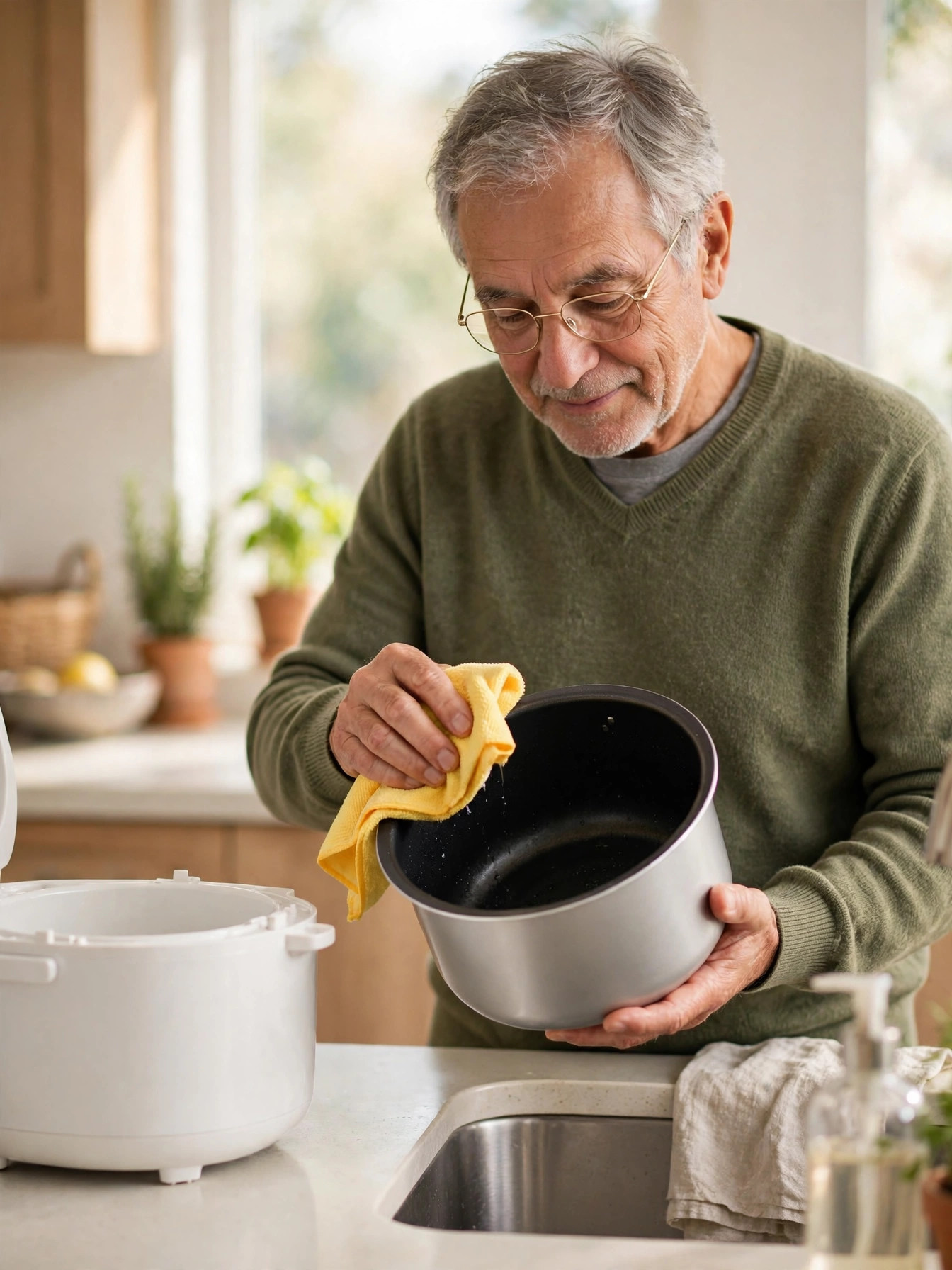
Do not soak the cooker body: only the inner pot, lid, and accessories are washable, since the outer body holds the electronics. If the nonstick coating is peeling or deeply scratched, a replacement pot is usually cheaper than a new cooker. When choosing between two similar models, favor the one with a removable lid and a fully washable inner pot, like the cookware in our best lightweight pans guide.
Rice and blood sugar: brown rice vs white rice
Brown rice keeps the bran and germ that white rice loses in milling, so it has more fiber and nutrients and tends to raise blood sugar more slowly; white rice is mostly starch and is digested more quickly.
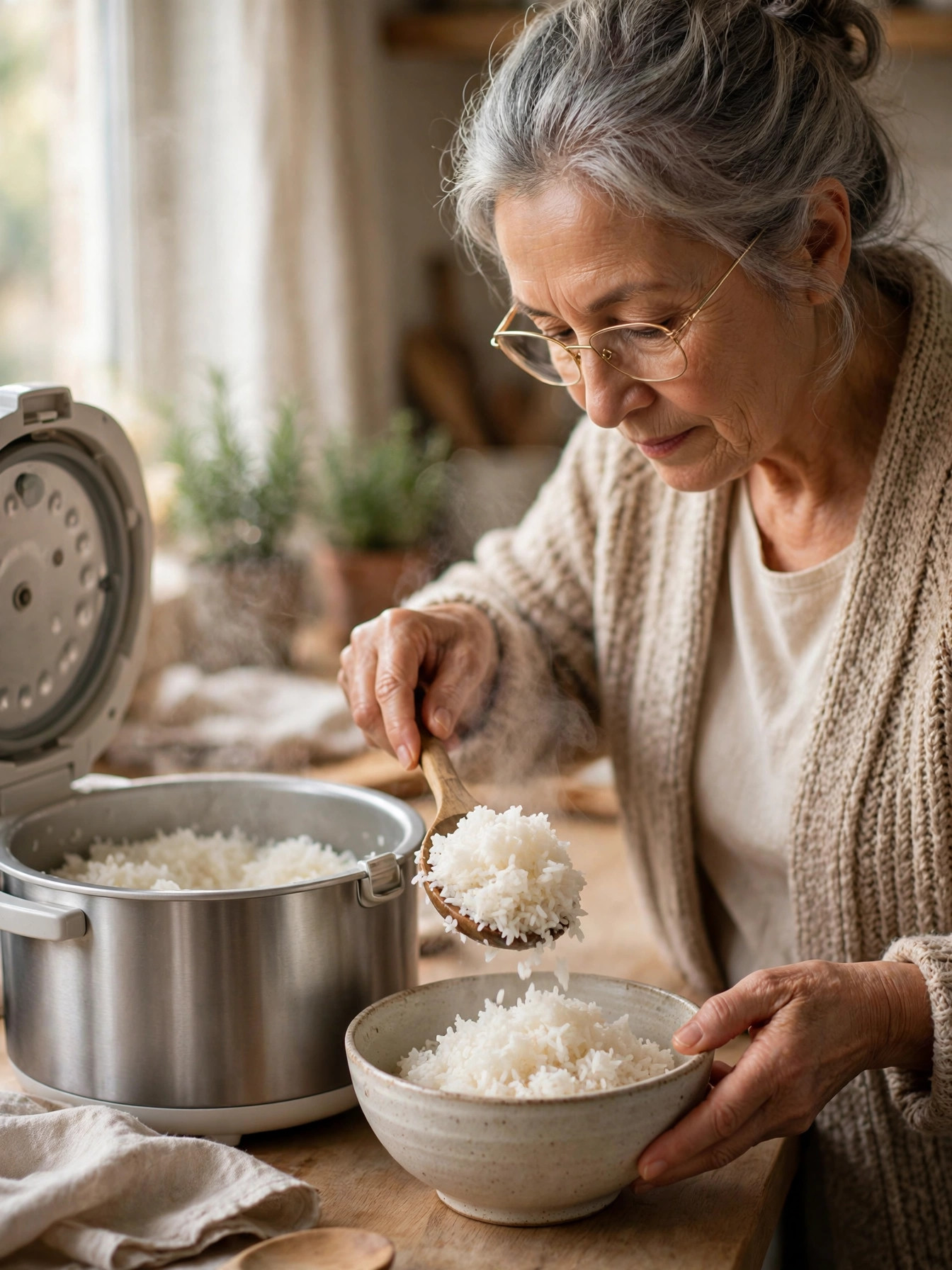
Evidence suggests the swap matters over time. In a large Harvard School of Public Health analysis of three long-running U.S. studies, researchers estimated that replacing about 50 grams of white rice a day (roughly a third of a serving) with the same amount of brown rice was associated with a 16% lower risk of type 2 diabetes, and replacing white rice with whole grains as a group with a 36% lower risk. These are associations from observational studies, not proof that the swap alone prevents diabetes. The Mayo Clinic similarly notes that whole grains, including brown rice, provide fiber and nutrients linked to a lower risk of heart disease and type 2 diabetes.
Portion size matters as much as type: fill about a quarter of your plate with rice and the rest with vegetables and protein, and measure your portion with the cooker’s cup rather than serving straight from the pot. Many fuzzy-logic cookers have a brown rice setting, which helps, since brown rice takes longer and needs more water. If you have diabetes or prediabetes, talk to your doctor or a registered dietitian about how much rice fits your eating plan. A rice cooker does not change what rice does to blood sugar — it only makes cooking it easier.
When to see a doctor
A rice cooker is a kitchen appliance, and this guide is about choosing one — not about diagnosing anything. But see your clinician promptly if you notice blood sugar readings that stay high, unusual thirst, frequent urination, or unexplained tiredness, numbness or weakness in your hands, hand pain or stiffness lasting more than a few days, or unplanned weight loss.
These can be signs of diabetes, nerve problems, arthritis, or another condition that deserves assessment. The Mayo Clinic advises making an appointment if joint pain or stiffness does not go away, and the NHS recommends seeing a GP for persistent symptoms. A dietitian can help you plan meals around your health.
The bottom line
The best rice cooker for seniors is the simplest one that fits your household: a light 3- to 5-cup model with one big switch, automatic keep-warm, and a removable nonstick pot. Fuzzy-logic and induction models cook more evenly and handle brown rice better, but only buy the extra features if you will use them. Serve the rice promptly and refrigerate leftovers within a couple of hours.
Sources
- Theis KA, et al. “Prevalence of Doctor-Diagnosed Arthritis and Arthritis-Attributable Activity Limitation — United States, 2016–2018.” CDC, MMWR 2021;70(40):1401–1405 — https://stacks.cdc.gov/view/cdc/159515/cdc_159515_DS1.pdf
- U.S. Department of Agriculture, FoodSafety.gov, “Four Steps to Food Safety: Clean, Separate, Cook, Chill” — https://www.foodsafety.gov/food-safety-charts/food-safety-four-steps (perishable food should not sit at room temperature more than 2 hours, or 1 hour above 90°F)
- UK Food Standards Agency, “Home food fact checker” (rice section) — https://www.gov.uk/government/publications/home-food-fact-checker (cool cooked rice quickly, ideally within one hour; do not leave rice in the rice cooker to cool; keep refrigerated rice no more than one day)
- Sun Q, et al. “White Rice, Brown Rice, and Risk of Type 2 Diabetes in US Men and Women.” Arch Intern Med. 2010;170(11):961–969 (Harvard School of Public Health) — https://pmc.ncbi.nlm.nih.gov/articles/PMC3024208/
- Mayo Clinic, “Whole grains: Hearty options for a healthy diet” — https://www.mayoclinic.org/healthy-lifestyle/nutrition-and-healthy-eating/in-depth/whole-grains/art-20047826
This article is for general information only and is not medical advice. Talk to your doctor about your personal health needs before changing how you manage a health condition.