Best Hand Grip Strengtheners for Seniors: Stronger Hands, Easier Days
Opening a jar used to take a second. Now it takes both hands, a rubber pad, and sometimes a request for help. Turning a key, holding a full kettle, keeping a grip on a grocery bag — these small tasks quietly become harder as the hands lose strength with age. A hand grip strengthener is one of the simplest, cheapest tools for pushing back: it fits in a drawer and works from a chair.
This guide explains what these tools do, the main types available, how to choose one that fits your hands and joints, and how to build a safe starter routine. It names no brands — instead, it gives you the features and safety rules to judge any grip strengthener yourself.

Why grip strength matters after 60
Grip strength is more than a measure of how hard you can squeeze. Researchers use it as a simple, widely studied marker of overall muscle strength and physical function in older adults. A review in Clinical Interventions in Aging found that grip strength tracks with upper-limb function, everyday activities, bone health, and future disability — which is why clinicians measure it so often.
Grip strength also declines with age. A Mayo Clinic study covered by the National Institutes of Health found that grip strength and knee strength fall measurably in the decades after age 50, even in healthy adults. That decline is normal, but it is not fixed: like other muscles, the hands and forearms respond to regular, gentle resistance work.
That matters because hands are involved in almost everything. Weak grip is linked to more difficulty with daily tasks — opening containers, carrying bags, holding a pen. No grip tool can treat arthritis or any other condition.
One caution: grip strength is a signal, not a diagnosis. A weak grip does not by itself mean you are ill. If your grip has weakened suddenly, or one hand is much weaker than the other, discuss it with your clinician.
Types of grip strengtheners
There is no single best design — different types suit different hands, goals, and joint conditions.
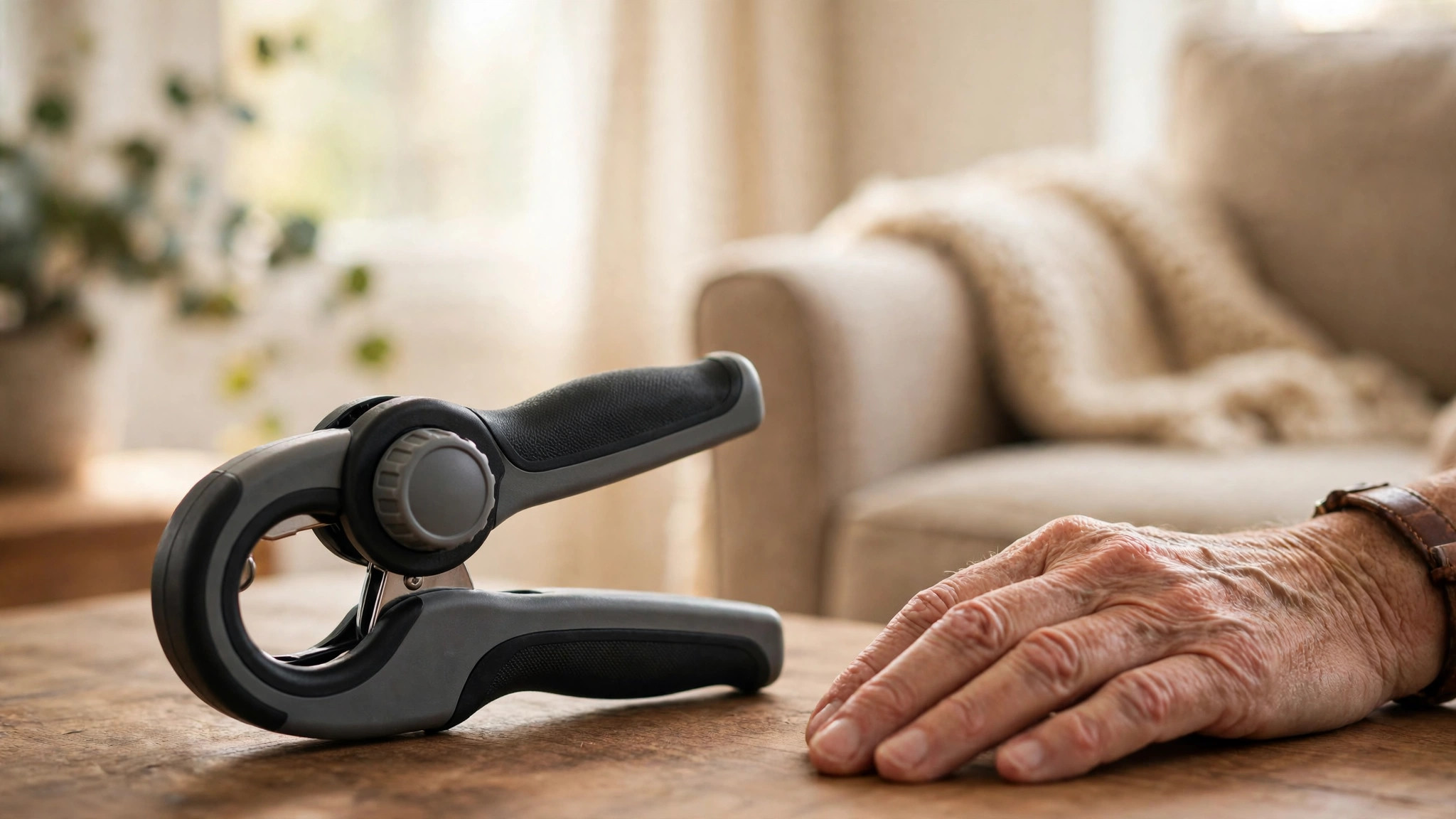
Spring-loaded hand grippers. The classic two-handle design with a metal coil spring: you squeeze the handles together against the spring’s resistance. Some have a fixed resistance; others have an adjustable dial. Fixed models are simple but limiting — once a resistance gets easy, you need a new tool. Adjustable models cost a little more and are usually the better buy, because you can start light and increase the load slowly.
Adjustable-resistance grippers. A dial or screw changes the tension, often across a wide range. These are the most practical choice for most seniors: start at the lightest setting, and turn the resistance up only when the current level feels easy for several sessions in a row. Look for a dial that moves smoothly and can be adjusted with one hand.
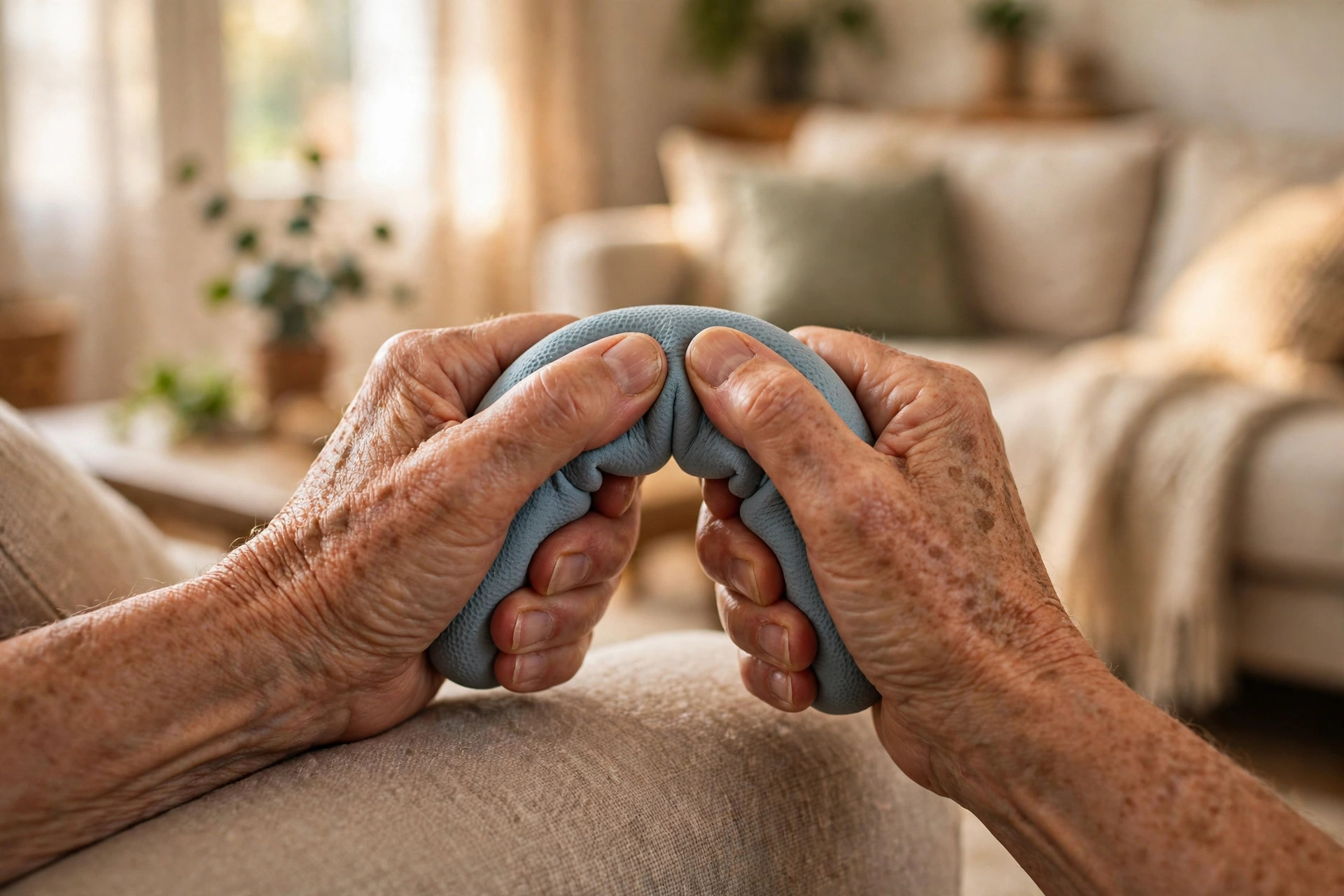
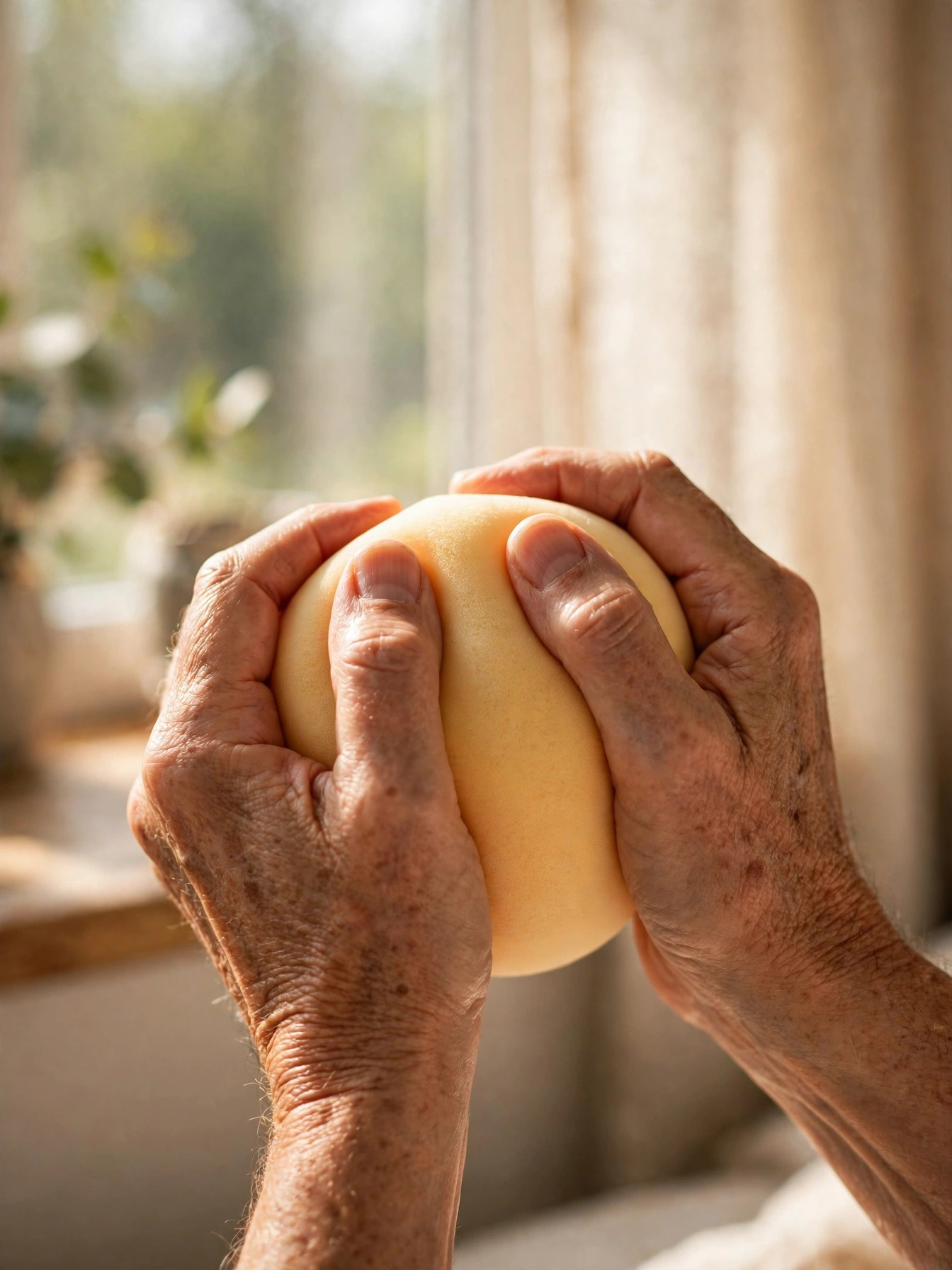
Foam grip balls and therapy putty. Soft, squeezable balls (often foam or gel-filled) and moldable putty are the gentlest option, offering low, even resistance that is kind to sore or stiff finger joints. You can squeeze a ball, roll putty between your fingers, or pinch it between thumb and fingertips to work different muscles. Therapists often recommend these for people with arthritis or after hand surgery, because the resistance is mild and the shape gives way under pressure instead of forcing the joints.
Finger exercisers and grip rings. Finger exercisers have individual buttons or bands for each finger, letting you train fingers one at a time. Grip rings are flexible rubber or silicone loops that you squeeze like a doughnut. Both target finger strength and dexterity rather than the whole-hand crush grip. They are light and quiet, but they offer limited resistance — better as a supplement to a main gripper than as your only tool.
How to choose: resistance, grip style, and hand size
Choosing the right grip strengthener is mostly about fit and comfort. A tool that hurts your hands or does not fit will sit unused in a drawer.
Start with the lightest resistance you can find. This is the single most important rule. Many grippers sold for general fitness start far too heavy for an older beginner, and squeezing against too much resistance strains tendons and finger joints. A good starter gripper should let you complete 8 to 10 slow squeezes without pain. If you cannot close it fully, or you need to brace it against your body, it is too heavy. Adjustable models solve this: set the dial to its lowest level and only move up when the current setting feels genuinely easy.
Match the grip style to your hands. Smooth plastic handles can slip if your hands sweat; textured or rubber-coated handles give a steadier hold. Spring grippers with hard, narrow handles can press painfully into the palm — look for wide, padded, or contoured handles that spread the pressure. Foam balls and putty are the most forgiving option if you have tender joints or thin skin. If you have arthritis, avoid tools that force your fingers into a tight, fixed position.
Check the size for your hands. A gripper designed for large hands can be impossible to hold comfortably if your hands are small — your fingers may not wrap far enough around the handles to get leverage. Foam balls and grip rings come in several diameters. Before buying, check the handle span: when you hold the tool relaxed, your fingertips should reach comfortably around it without stretching. If you shop in person, try the display model; if you shop online, look for a stated size range and a clear return policy.
A safe starter routine
A grip routine should feel like gentle exercise, not a test of willpower: steady, pain-free practice a few times a week, not maximum effort.

Start with two or three short sessions a week, on days when your hands feel reasonably comfortable:
- Warm up first. Spend a minute opening and closing your hands slowly, spreading your fingers wide, then making a loose fist. Move slowly and smoothly, and stop if anything hurts — the same rule the Mayo Clinic gives for hand exercises.
- Squeeze and release slowly. Hold your gripper or ball, squeeze gently for about two seconds, then release slowly over two seconds. Aim for 8 to 10 repetitions per hand. Rest for a minute, then repeat once more if your hands feel fine.
- Add a finger stretch. After squeezing, open your hand wide and stretch your fingers apart for a few seconds. This balances the gripping muscles with the muscles that open the hand.
- Alternate hands and tools. If you have a ball and a gripper, alternate between them across the week. Variety spreads the load across different muscles.
Progress slowly. When 10 slow squeezes feel easy for two sessions in a row, add a few more repetitions — or, on an adjustable gripper, turn the dial up one small step. Never increase resistance and repetitions at the same time. Mild forearm fatigue is normal; sharp pain, aching that lasts into the next day, or swelling is a sign to back off.
The U.S. Centers for Disease Control and Prevention recommends muscle-strengthening activities on two or more days a week for older adults. A grip routine fits neatly into that pattern — a small piece of a broader strength habit, alongside the light resistance work in our guides to resistance bands and dumbbell exercises.
Common mistakes to avoid
Squeezing as hard as you can. Maximum-effort squeezes strain tendons and raise blood pressure briefly. Slow, controlled squeezes at a comfortable resistance build more usable strength with less risk.
Training through pain. Soreness in the forearm muscles after a first session is normal and fades. Pain in a finger joint, the wrist, or the thumb base is not normal. The Mayo Clinic’s advice applies here too: if an exercise causes pain, stop, rest, and try again later with less intensity — and if the pain continues, talk with your healthcare professional or a physical therapist.
Using only one grip. Hands do more than crush. Pinching, holding, and opening all matter for daily life. A routine that only squeezes a spring gripper misses the pinching and spreading movements. Mix in a foam ball, some putty, or simple finger stretches.
When to see a doctor
A grip strengthener is a fitness tool, not a treatment. See your clinician or a hand therapist if you notice:
- Sudden weakness in one hand, or a grip that has weakened noticeably over a short time
- Numbness, tingling, or burning in the fingers or hand, especially at night
- A finger that locks, catches, or cannot straighten
- Swelling, redness, or warmth in a hand joint that does not settle in a few days
- Pain that persists or worsens despite resting the hand
- You have rheumatoid arthritis, carpal tunnel syndrome, a recent hand injury, or surgery, and you are unsure whether grip exercise is safe
People with arthritis often benefit from hand exercises — the Arthritis Foundation and Mayo Clinic both describe gentle hand movements as a way to support joint flexibility — but the right exercises and resistance depend on the individual. If you have an inflammatory condition or a hand diagnosis, ask your clinician or a physical therapist which grip tool, if any, suits you before buying one. Our guide to hand arthritis exercises covers gentle movements that pair well with a grip routine.
The bottom line
The best hand grip strengthener for seniors is not the strongest or the most expensive one. It is the lightest, most comfortable tool that fits your hands and that you will actually use a few times a week: usually an adjustable-resistance gripper — or a soft foam ball or putty if your joints are tender — used slowly, gently, and consistently. Stronger hands will not fix every task, but they may help the small ones — the jar, the key, the kettle — feel easy again.
Sources
- Bohannon, R.W., “Grip Strength: An Indispensable Biomarker For Older Adults,” Clinical Interventions in Aging, 2019 — https://pubmed.ncbi.nlm.nih.gov/31631989/
- National Institutes of Health, “Assessing ways to gauge aging status” (Mayo Clinic grip-strength study) — https://www.nih.gov/news-events/nih-research-matters/assessing-ways-gauge-aging-status
- Mayo Clinic, “Hand exercises for people with arthritis” — https://www.mayoclinic.org/diseases-conditions/arthritis/in-depth/arthritis/art-20546847
- Centers for Disease Control and Prevention, “Physical Activity Basics for Older Adults” — https://www.cdc.gov/physical-activity-basics/guidelines/adults.html
- Arthritis Foundation, “Hand Exercises for Arthritis” — https://www.arthritis.org/health-wellness/healthy-living/physical-activity/other-activities/hand-exercises-for-arthritis
- National Institute on Aging, “Exercise and Physical Activity for Older Adults” — https://www.nia.nih.gov/health/exercise-and-physical-activity
This article is for general information only and is not a substitute for professional medical advice. Talk to your clinician before starting any new exercise or treatment.