

Sleep Apnea After 60: 7 Warning Signs Most People Ignore
Most people think of sleep apnea as a loud snorer’s problem — annoying, maybe, but harmless. In reality, obstructive sleep apnea is common after 60, frequently undiagnosed, and linked to some of the most serious health conditions of later life: high blood pressure, heart disease, and stroke.
The good news is that it is also very treatable once it is found. The catch: many of its warning signs look like ordinary aging — fatigue, forgetfulness, nighttime bathroom trips. Here are the seven signs worth paying attention to, why apnea matters more after 60, and what happens if you bring your concerns to a doctor.
What sleep apnea actually is
In obstructive sleep apnea, the muscles at the back of the throat relax too much during sleep, narrowing or closing the airway. Breathing stops or becomes shallow for seconds at a time, sometimes dozens of times an hour. Oxygen levels dip, the brain briefly rouses you to restart breathing, and the cycle repeats.
You usually don’t fully wake up, so you may have no memory of these interruptions. But the constant fragmentation keeps you from reaching deep, restorative sleep — and the repeated drops in oxygen put strain on the heart and blood vessels night after night.
Apnea becomes more common with age: throat muscles lose tone, and weight gain around the neck — common in midlife — adds pressure to the airway. It is estimated that a substantial share of older adults have sleep apnea, and many don’t know it.
The 7 warning signs
1. Loud, frequent snoring
Snoring alone doesn’t prove apnea — plenty of people snore without it. But loud, nightly snoring is the most common visible sign. It suggests the airway is partially blocked, and when it is severe enough, that blockage becomes apnea.
Take it more seriously if the snoring is very loud, happens most nights, and is broken by pauses or gasps. If a partner has to sleep in another room, that’s worth mentioning to your doctor.
2. Pauses in breathing noticed by a partner
This is one of the strongest clues. A bed partner may notice that your breathing stops for several seconds, sometimes followed by a loud snort or gasp as breathing restarts. Some partners describe it as frightening to watch.
If you sleep alone, this sign is easy to miss — but a partner who reports it is giving you valuable information. Don’t dismiss it.

3. Waking up gasping or choking
Occasionally jerking awake with a gasp, or a sensation of choking, is a classic apnea sign. These awakenings are brief — you may fall back asleep within seconds — but they indicate that the airway closed enough to trigger an emergency arousal.
If this happens regularly, or if your partner sees it often, it’s worth getting checked.
4. Morning headaches
Waking with a dull headache, especially at the front of the head, can be a sign of apnea. The theory: overnight drops in oxygen and rises in carbon dioxide dilate blood vessels in the brain, leaving you with a headache that usually fades within a few hours of waking.
Not every morning headache is apnea — but if they happen several mornings a week alongside snoring or fatigue, the pattern is worth noting.
5. Daytime sleepiness that feels out of proportion
Feeling drowsy during the day despite spending enough hours in bed is one of the hallmark symptoms. It can look like dozing off in front of the television, struggling to stay awake while reading, or — most dangerously — fighting sleepiness while driving.
Be honest with yourself about this one. Some fatigue is normal with age, and sleep changes after 50 can explain part of it. But apnea-related sleepiness tends to be persistent and hard to explain by poor habits alone — you can sleep eight hours and still wake unrefreshed.
6. Difficulty concentrating or “brain fog”
Poor sleep shows up in the mind before anywhere else. People with untreated apnea often report trouble focusing, forgetfulness, slower thinking, or a general sense of mental fogginess. Family members may notice it first.
Because these symptoms overlap with normal aging — and with early cognitive decline — they are among the most commonly dismissed. The difference: apnea-related thinking problems often improve once the apnea is treated, which makes identifying them all the more worthwhile.
7. High blood pressure that’s hard to control
This is the sign most people never connect to sleep. Apnea repeatedly stresses the cardiovascular system at night, and it is linked to high blood pressure that resists treatment — sometimes called resistant hypertension. Studies have also found links between untreated apnea and a higher risk of heart attack, stroke, atrial fibrillation, and type 2 diabetes.
If your blood pressure is difficult to bring down despite medication, or you’ve been told it’s especially high in the morning, sleep apnea is worth considering as a contributing factor. This is also the sign that makes apnea more than a sleep problem: left untreated, it steadily raises cardiovascular risk.
Why untreated apnea matters more after 60
A younger person’s heart and vessels can absorb years of nightly oxygen dips. After 60, the margin for error is smaller — and the consequences land sooner.
The clearest evidence concerns the cardiovascular system. Research has consistently linked untreated obstructive sleep apnea to high blood pressure, atrial fibrillation, heart failure, stroke, and type 2 diabetes. The relationship appears to run in both directions: apnea strains the heart, and cardiovascular disease can make apnea worse.
There is also growing evidence connecting poor sleep and repeated oxygen deprivation to cognitive problems. While researchers are still working out the details, fragmented sleep and low oxygen are suspected of contributing to the memory and thinking difficulties that worry so many older adults.
The point isn’t to frighten you — it’s to explain why apnea deserves the same attention as blood pressure or cholesterol. It is a modifiable risk factor: treated, the danger falls.
How sleep apnea is diagnosed
Diagnosis starts with a conversation. Tell your doctor about the signs you’ve noticed — snoring, pauses, daytime sleepiness — and any blood pressure problems. A partner’s observations are genuinely useful here, so bring them along if you can.
The main test is a sleep study (polysomnography), usually done overnight in a sleep clinic. Sensors track your breathing, oxygen levels, heart rhythm, and brain activity while you sleep. It sounds high-tech, but it’s painless — most people sleep through it.
Many doctors now start with home sleep tests: a simpler device you wear for a night or two in your own bed. Home tests are less detailed but adequate for detecting typical obstructive apnea in many people, and they’re far more comfortable and convenient.
Neither test requires a referral to a specialist in most cases — your primary care doctor can usually order one.

What treatment looks like
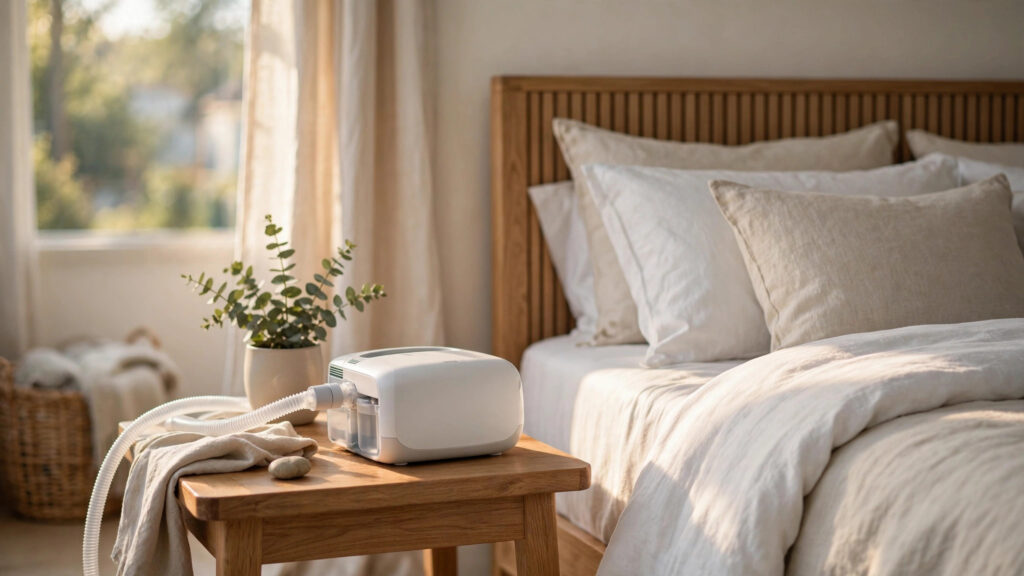
The standard treatment for moderate to severe apnea is CPAP — continuous positive airway pressure. A small bedside machine delivers gently pressurized air through a mask, keeping the airway open through the night. Modern machines are quiet, and masks have become much less intrusive than the bulky versions of the past.
Many people notice a difference quickly: less snoring, clearer mornings, better daytime alertness. Adherence can take adjustment — some people need to try a few masks or use a ramp feature that eases pressure up gradually — but most people who stick with it find it becomes routine within a few weeks.
Other approaches your doctor may discuss:
- Lifestyle measures: losing excess weight, avoiding alcohol in the evening, and sleeping on your side may help reduce apnea severity, especially in milder cases. These are worth doing regardless, but they’re rarely enough on their own for moderate-to-severe apnea.
- Oral appliances: a dentist-fitted device that holds the jaw forward can help mild to moderate apnea, particularly for people who can’t tolerate CPAP.
- Positional therapy and other options: for apnea that happens mainly on the back, positional devices may help; surgery is an option only in specific, carefully selected cases.
What treatment doesn’t look like is a prescription from an article. The right approach depends on the severity of your apnea and your overall health, which is exactly why a proper diagnosis comes first.
When to see a doctor
Several of the signs above warrant prompt evaluation rather than a wait-and-see approach. Talk to your doctor soon if you notice any of the following:
- Your breathing pauses during sleep have been witnessed by a partner — repeatedly
- You wake gasping or choking more than occasionally
- You fall asleep unintentionally during the day — especially while driving, or in conversations
- Your blood pressure remains high despite treatment, or you have heart disease, atrial fibrillation, or a history of stroke alongside snoring and daytime sleepiness
- Morning headaches happen most days and don’t have another explanation
- Daytime fatigue is severe enough to interfere with daily life, work, or safety
And even without an urgent red flag: if you have three or more of the seven signs above, bring it up at your next appointment. A sleep study is straightforward, treatment is effective, and many people say they wish they’d been evaluated years earlier.
The bottom line
Loud snoring, witnessed pauses, gasping at night, morning headaches, unexplained daytime sleepiness, trouble concentrating, and stubborn high blood pressure — any one of these can have other causes, but together they paint a recognizable picture. Sleep apnea after 60 is common, underdiagnosed, and very treatable. If you recognize yourself in this article, the next step is simple: mention it to your doctor.
Sources
- National Heart, Lung, and Blood Institute (NHLBI), “Sleep Apnea” — https://www.nhlbi.nih.gov/health/sleep-apnea
- American Heart Association, “Sleep Apnea and Heart Disease, Stroke” — https://www.heart.org/en/health-topics/sleep-disorders/sleep-apnea-and-heart-disease-stroke
- Cleveland Clinic, “Obstructive Sleep Apnea” — https://my.clevelandclinic.org/health/diseases/8718-sleep-apnea
- NHS, “Sleep apnoea” — https://www.nhs.uk/conditions/sleep-apnoea/
This article is for general information only and is not medical advice. Talk to your doctor or a qualified health professional about your personal situation.