
Vitamin B12 and Calcium After 50: The Two Nutrients Most People Miss
You can eat perfectly reasonable meals and still run short on two nutrients after 50: vitamin B12 and calcium. Not because your diet got worse — but because your body’s ability to absorb and hold on to them quietly changes with age.
Neither shortfall announces itself. Low B12 creeps up as fatigue or a vague sense that your memory isn’t what it was. Low calcium works in silence, thinning bone year after year until a minor fall becomes a fracture. Below: why absorption drops after 50, the signs worth noticing, who is most at risk, what to eat, when supplements make sense, and how to get tested without guessing.
Part 1: Vitamin B12 — the absorption problem
Vitamin B12 keeps your nerves working, helps form red blood cells, and plays a role in DNA production. Your body can’t make it — every microgram has to come from food or supplements. And here’s the catch that matters most after 50: the older you get, the harder it becomes to absorb the B12 in your food.
Why absorption declines with age
Getting B12 out of food is a multi-step job, and stomach acid is step one. In food, B12 is bound to protein. Stomach acid and enzymes free it, then it attaches to a carrier protein called intrinsic factor (made in the stomach), which escorts it through the intestines into the blood.
After 50, that machinery starts to wear. An estimated 10–30% of adults over 50 have atrophic gastritis — thinning of the stomach lining that reduces acid and intrinsic factor production, so less B12 gets freed from food. In pernicious anemia, an autoimmune condition, the body attacks the stomach cells that make intrinsic factor — without it, almost no food-based B12 is absorbed. Smaller appetites, dental issues, and tighter budgets can further reduce intake of B12-rich animal foods.
The important nuance: this is mainly a problem with B12 from food. The B12 in fortified foods and supplements is already in free form — it doesn’t need stomach acid to be released. So people who struggle to absorb B12 from food can often absorb a supplement just fine.
Symptoms of deficiency
B12 deficiency develops slowly, often over years, because the liver stores a reserve. Early symptoms are easy to blame on “just getting older”:
- Fatigue and weakness — the most common early sign; may come with pale skin as anemia develops
- Tingling or numbness in the hands and feet — a classic nerve symptom
- Balance problems — unsteadiness, especially in the dark
- Memory trouble and brain fog — difficulty concentrating, feeling mentally slow
- Mood changes — irritability or low mood
- A sore, red tongue or mouth sores
One point worth taking seriously: prolonged deficiency can damage nerves, and nerve damage that goes on too long may not fully recover. Symptoms are reversible when caught early — which is the strongest argument for testing rather than waiting.

Who is at higher risk
Some people face a double hit — lower absorption and lower intake:
- Adults over 50 generally — age-related absorption decline is common even with a good diet
- Vegetarians and vegans — B12 comes almost exclusively from animal foods, so plant-based eaters need a reliable fortified source or supplement
- Long-term users of acid-reducing medications — proton pump inhibitors (like omeprazole) and H2 blockers reduce the stomach acid needed to free B12 from food
- People taking metformin — the widely used diabetes drug is linked to lower B12 levels with long-term use
- People with digestive conditions — celiac disease, Crohn’s disease, pernicious anemia, or a history of stomach or intestinal surgery
Food sources that actually deliver
B12 comes from animal foods. Strong sources include:
- Shellfish — clams are the standout; a small serving covers several days’ worth
- Fish — sardines, salmon, tuna, trout
- Meat — beef, liver (very rich), chicken
- Dairy — milk, yogurt, cheese
- Eggs
For vegetarians and vegans, the reliable options are fortified ones: nutritional yeast labeled as B12-fortified, fortified plant milks, and fortified breakfast cereals. Check the label — “enriched” doesn’t always mean B12 is included.
The adult recommended intake is small — 2.4 micrograms per day — but that’s a target for healthy absorption. If your absorption is impaired, hitting the number on paper doesn’t mean your body is getting it.
Supplements and testing
Because supplement B12 is in free form, it bypasses the stomach-acid problem:
- A daily B12 supplement or multivitamin is a reasonable safety net for adults over 50, especially vegetarians, vegans, and long-term PPI or metformin users. The standard form, cyanocobalamin, is well studied and inexpensive.
- High-dose oral B12 (often 1,000 micrograms daily) is commonly used to correct deficiency — even a small percentage absorbed from a large dose adds up.
- Injections exist for people who can’t absorb oral B12 at all, but that’s a doctor’s decision, not a DIY one.
To know where you stand, ask your doctor for a serum B12 blood test. If the result is borderline, follow-up markers — methylmalonic acid (MMA) or homocysteine — can clarify, since they rise when B12 is functionally low. Don’t supplement heavily right before testing without telling your doctor; it can mask the result.
Part 2: Calcium — the quiet drain
Calcium is best known as the bone mineral — about 99% of the body’s calcium sits in bones and teeth. It’s also essential for muscle function, nerve signaling, and blood clotting. After 50, keeping calcium intake adequate gets harder at exactly the time your bones need it most.
Why needs rise after 50
- Bone loss accelerates. From around midlife, bone breakdown outpaces rebuilding — gradually and painlessly.
- Menopause speeds it up. The estrogen drop after menopause accelerates bone loss, raising osteoporosis risk for women over 50.
- Men lose bone too — more slowly, but it adds up, which is why targets rise for men after 70.
- Absorption efficiency falls. The gut absorbs a smaller share of dietary calcium with age.
How much do you need?
Per the National Institute on Aging:
- Women 51 and older: 1,200 mg per day
- Men 51–70: 1,000 mg per day
- Men 71 and older: 1,200 mg per day
- Upper limit for all adults over 50: 2,000 mg per day from all sources combined
National surveys consistently show older adults averaging well under these targets — especially women who avoid dairy.
Food sources that actually deliver
Food-first is the preferred approach, and the list is wider than most people think:
- Yogurt — a cup of plain yogurt delivers roughly 300–400 mg
- Milk — about 300 mg per cup
- Cheese — hard cheeses like parmesan are concentrated sources, roughly 200–300 mg per ounce
- Canned sardines or salmon with bones — the soft bones are edible and calcium-rich
- Leafy greens — kale, bok choy, and collard greens are well absorbed; spinach is high in calcium but much of it is bound by oxalates and poorly absorbed
- Calcium-set tofu — check the label; it can rival dairy per serving
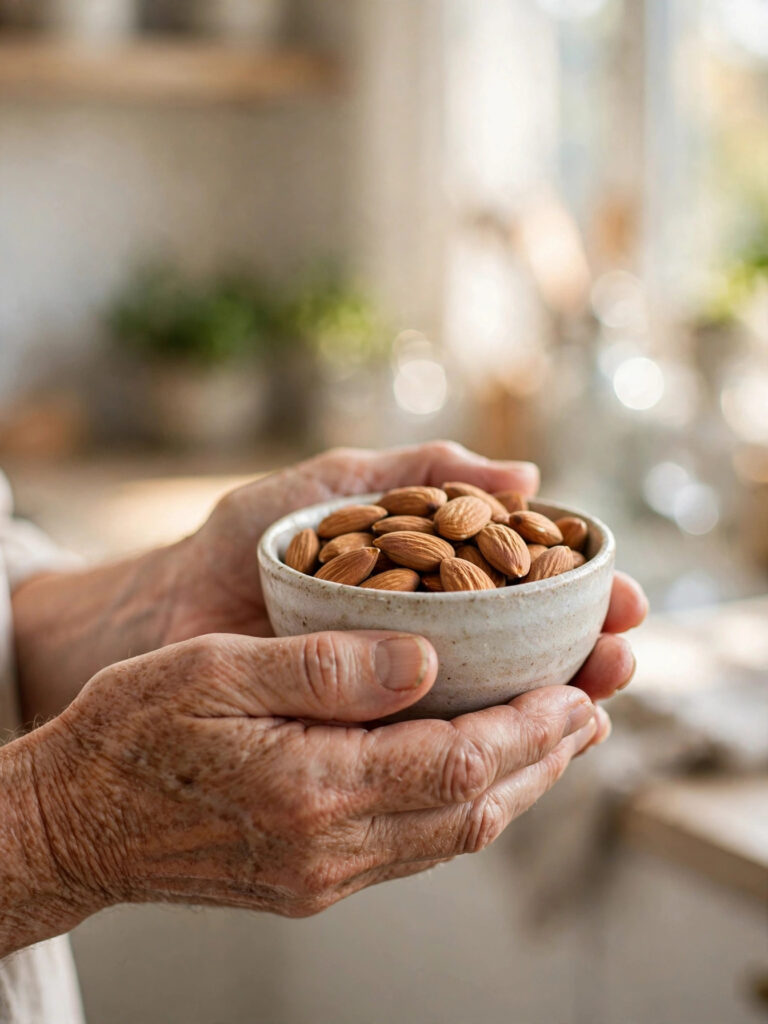
- Almonds — around 75 mg per ounce
- Fortified foods — fortified plant milks, fortified orange juice, some fortified cereals
A day with yogurt at breakfast, a handful of almonds as a snack, and sardines or tofu at dinner can get you most of the way to 1,200 mg without any pills.
The vitamin D connection
Calcium is a two-nutrient story: your body can’t absorb calcium well without enough vitamin D. Vitamin D controls how much calcium the gut takes up, and vitamin D status also tends to decline with age — so it’s common to be low in both at once. If you’re working on calcium, make sure your vitamin D is adequate too (see our guide on vitamin D after 50).

When a modest supplement may make sense
If diet alone consistently falls short — lactose intolerance, a dairy-free diet, or simply a small appetite — a modest supplement can fill the gap:
- Supplement the gap, not the whole target. If your diet provides ~700 mg, a 500 mg supplement gets you to 1,200 mg. More is not better.
- Split larger doses. The body absorbs calcium best in doses of 500 mg or less at a time — take half in the morning and half in the evening.
- Know the two main forms. Calcium carbonate is inexpensive and best taken with food; calcium citrate can be taken any time and may suit people with low stomach acid.
- Stay under 2,000 mg total per day from food plus supplements, and check your multivitamin’s calcium content before adding a separate pill.
Evidence suggests moderate supplementation is generally safe for most people, but very high intakes from supplements have been questioned in some studies — one more reason food-first is the better default.
A simple weekly check-in
Once a week, ask yourself three quick questions:
- Did I eat a calcium-rich food most days (yogurt, milk, fortified plant milk, sardines, leafy greens, tofu)?
- Did I get B12 most days (fish, eggs, dairy, meat — or a fortified food or supplement if plant-based)?
- Am I in a higher-risk group for B12 (over 50, vegetarian, long-term PPI or metformin use) without a supplement or recent test?
Three yeses, and you’re likely in good shape. Any “no” is a nudge, not an emergency — adjust one meal or raise it at your next doctor’s visit.

When to see a doctor
Book an appointment if:
- You have persistent fatigue, tingling or numbness in your hands or feet, balance problems, or memory changes — these warrant a B12 check, not self-diagnosis
- You’ve had a fracture from a minor fall or bump — that deserves a full bone-health workup, including calcium, vitamin D, and possibly a bone density scan
- You take metformin or acid-reducing medication long-term — ask whether B12 monitoring makes sense for you
- You follow a vegan diet — a B12 supplement or test should be part of your routine
- Your total calcium intake may exceed 2,000 mg/day, or you’re considering more than 1,000 mg/day from supplements
- You have kidney disease, a history of kidney stones, or a thyroid/parathyroid condition — calcium and supplement decisions need professional guidance here
The bottom line
After 50, vitamin B12 and calcium share the same problem: your body gets less from what you eat, right when steady supply matters most. The fix is practical. Eat B12-rich foods or take a simple supplement — especially if you’re over 50, plant-based, or on long-term stomach-acid or diabetes medication. Eat calcium-rich foods daily, keep vitamin D in the picture so the calcium gets absorbed, and use a modest supplement only to close a real gap. And when symptoms show up — fatigue, tingling, memory fog, or a fracture that shouldn’t have happened — get tested instead of guessing.
Sources
- National Institute on Aging (NIA), “Vitamin B12 and Older Adults” — https://www.nia.nih.gov/health/vitamins-and-supplements/vitamin-b12-and-older-adults
- National Institutes of Health, Office of Dietary Supplements, “Vitamin B12 — Fact Sheet for Health Professionals” — https://ods.od.nih.gov/factsheets/VitaminB12-HealthProfessional/
- National Institutes of Health, Office of Dietary Supplements, “Calcium — Fact Sheet for Health Professionals” — https://ods.od.nih.gov/factsheets/Calcium-HealthProfessional/
- Mayo Clinic, “Vitamin deficiency anemia” (symptoms and causes) — https://www.mayoclinic.org/diseases-conditions/vitamin-deficiency-anemia/symptoms-causes/syc-20355025
- NHS, “Calcium” (vitamins and minerals guide) — https://www.nhs.uk/conditions/vitamins-and-minerals/calcium/
This article is for general information only and is not medical advice. Talk to your doctor or a registered dietitian about your personal nutrition needs.