Best Yoga Blocks and Straps for Seniors: Gentler, Steadier Practice
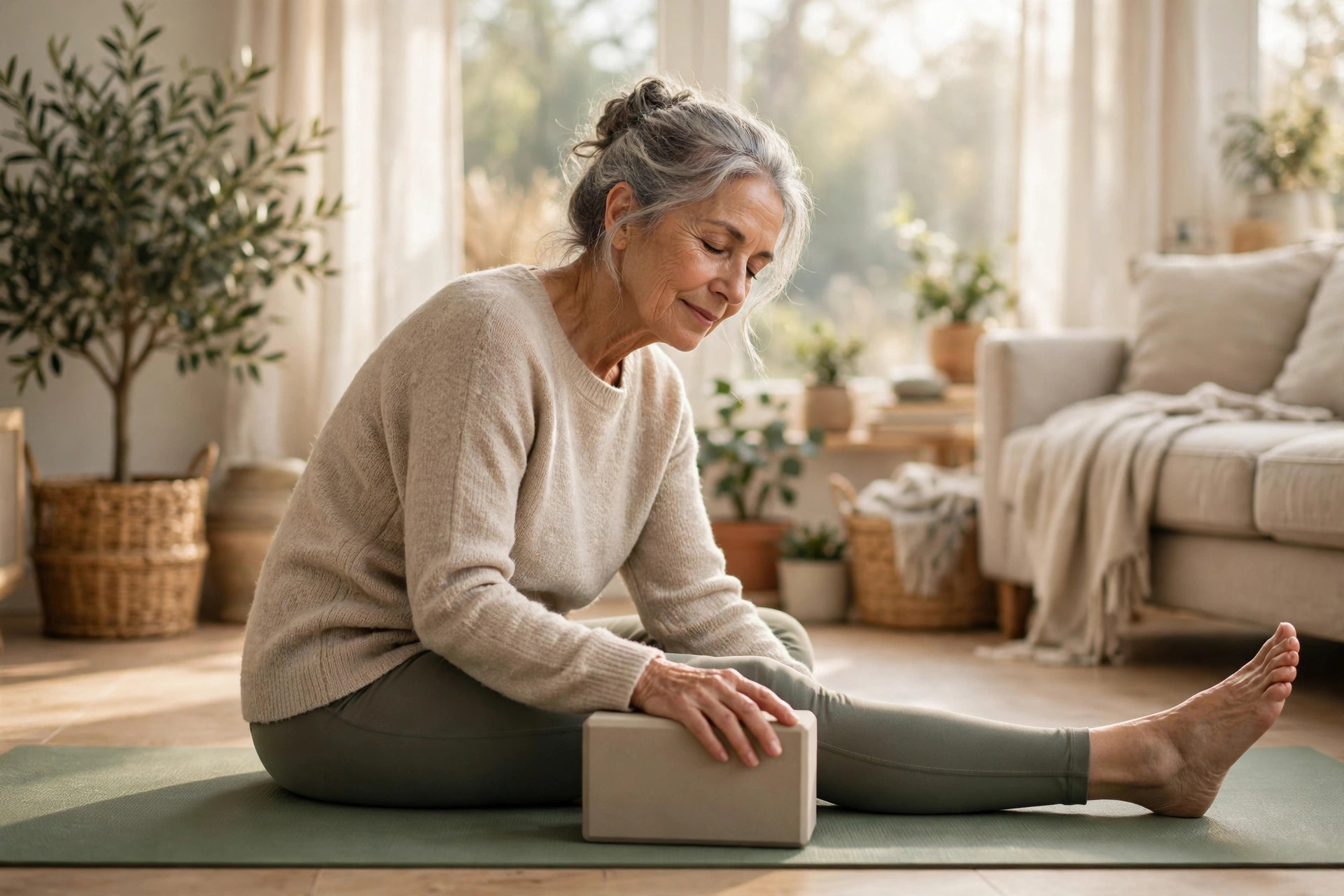
If yoga after 60 sometimes feels like the floor is a long way down, you are not doing it wrong — your body has simply changed. That is exactly what yoga props are for: a block brings the floor up to meet your hand, and a strap brings your foot up to meet your hand.
Props are not training wheels: blocks and straps have been standard equipment in Iyengar-style yoga for decades. This guide covers foam versus cork blocks, block sizes, strap length, and buckle types — so you can buy once and buy well.
As an Amazon Associate, we earn from qualifying purchases.
Why props matter more after 60
Flexibility naturally declines with age: muscles lose elasticity, tendons stiffen, and the hips, shoulders, and spine move less freely. A block or strap closes the distance, so instead of straining toward the floor or your toes, you meet the pose halfway. It adds stability — a hand resting on a block is far steadier than a hand waving in the air — and it takes pressure off sore joints by spreading the load.
The National Center for Complementary and Integrative Health (NCCIH) notes that studies have suggested yoga may help with balance: in a 2014 review, 11 of 15 studies found improvements in at least one balance outcome. In the SAGE trial (The Lancet Healthy Longevity), a standing-posture-heavy yoga program was linked to more falls than a seated program among adults 60 and older — a reason to favor supported, prop-assisted practice over ambitious standing work. Our gentle yoga poses for seniors guide follows the same safety-first approach.
How blocks help
A yoga block is a firm brick, usually about 9 inches long, 6 inches wide, and 4 inches thick, that you can stand on any of its three faces for three different heights. In a forward fold, a block under your hand raises the “floor” by 4 to 9 inches, so your back stays flat instead of rounding. In a seated twist or supported bridge, a block under the lower back holds you in position.
Buy blocks in pairs, since many poses use one on each side; one block still helps in seated poses if budget is tight.
Foam vs cork vs wood blocks
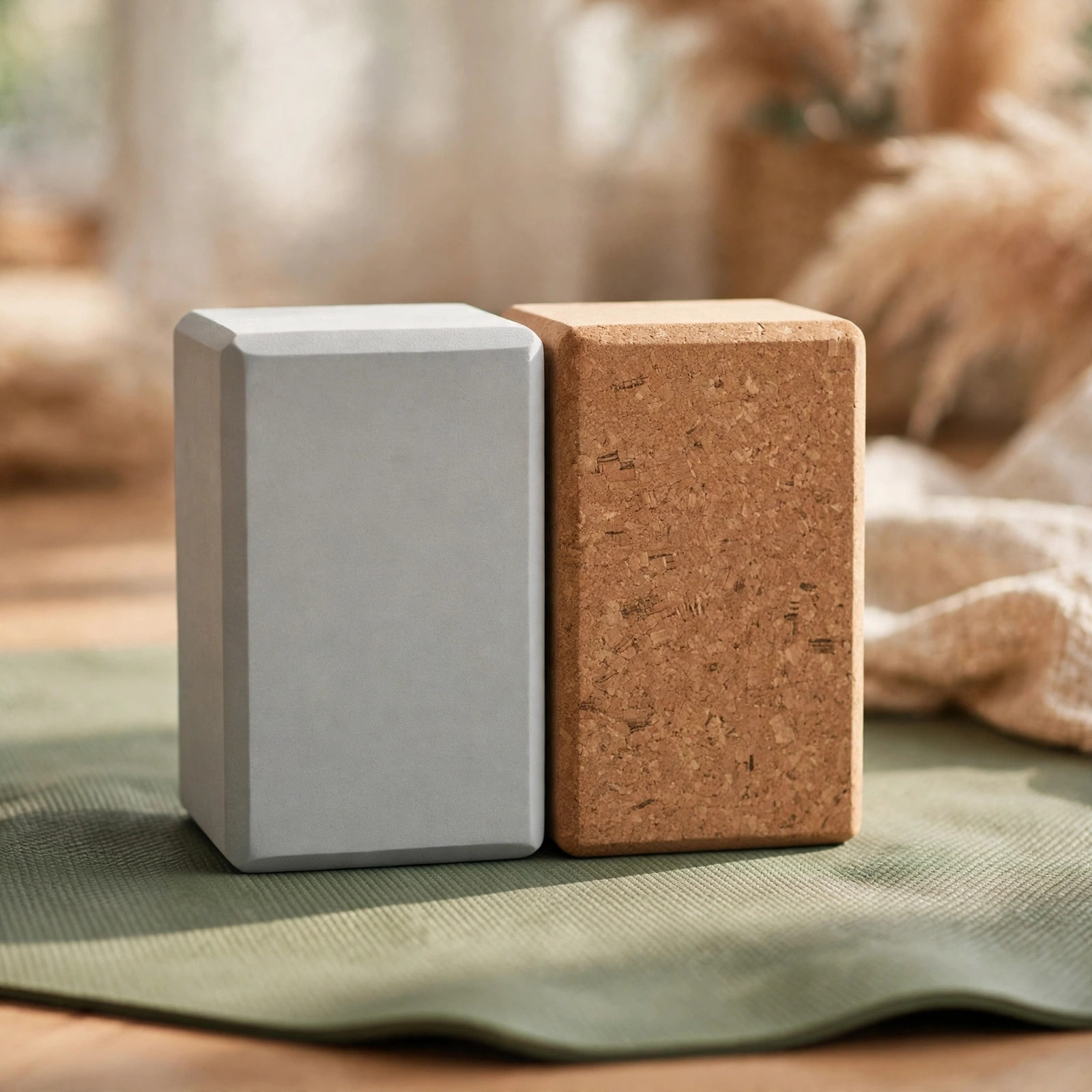
Foam blocks (EVA foam) are the usual starting point. They are light — usually under half a pound each — and easy to carry and move mid-pose. High-density foam has a slightly tacky, non-slip surface and enough give to be comfortable under a knee or hip, and it is the least expensive option. The trade-off: cheap, low-density foam compresses under body weight and can feel wobbly in standing poses. Press your thumb into the foam — it should give only slightly, then spring back.
Cork blocks are denser, heavier (around 1 to 2 pounds each), and very stable — they barely compress at all, which makes them excellent for standing poses. Cork also grips better when hands are sweaty and naturally resists odour. The downsides are weight and hardness: a cork block is less forgiving under a sore knee, and lifting two of them is noticeably more effort. For mainly gentle or restorative yoga, foam is usually the more comfortable choice.
Wood blocks are the firmest, heaviest, and least forgiving — made for advanced practitioners and studio use. For most seniors they offer no advantage over cork. You can safely skip them.
| Material | Weight | Grip | Comfort | Best for |
|---|---|---|---|---|
| High-density foam | Very light | Good, slightly tacky | Soft, forgiving | Most seniors, gentle practice |
| Cork | Heavy | Excellent, even when sweaty | Firm, minimal give | Standing poses, maximum stability |
Block sizes and shapes
The standard block measures about 9 by 6 by 4 inches, and that size suits most people: its three faces give you three usable heights — 4, 6, or 9 inches. If you buy only one size, buy this one.
Variations: slim blocks (9 x 6 x 3 inches) for small hands; large blocks (about 10 x 6 x 5 inches) that bring the floor closer in standing poses; and wedges that sit at an angle under the wrists or heels. Whatever size you choose, pick bevelled edges and a textured surface, and pair the block with a mat that grips well — our guide to the best yoga mats for older adults covers thickness and cushioning for sensitive knees.

2. Gaiam Essentials Thick Yoga Mat (10mm)
10mm thick cushioning – the joint-friendly mat for floor exercises.
Yoga straps: length, material, and buckles
A yoga strap is a long, flat belt that extends your reach — loop it around a foot you cannot quite touch, or hold it behind your back when your hands cannot quite meet. For seniors, the strap may be even more useful than the block, because tight hamstrings and stiff shoulders are exactly what it works around.
Length. Straps come in 6, 8, and 10 feet; 6 feet suits most people under about 5 feet 10 inches. An 8-foot strap is the better default for older adults: extra slack lets you hold it with a relaxed grip and still reach your foot. A 10-foot strap suits taller people. If unsure, choose 8 feet.
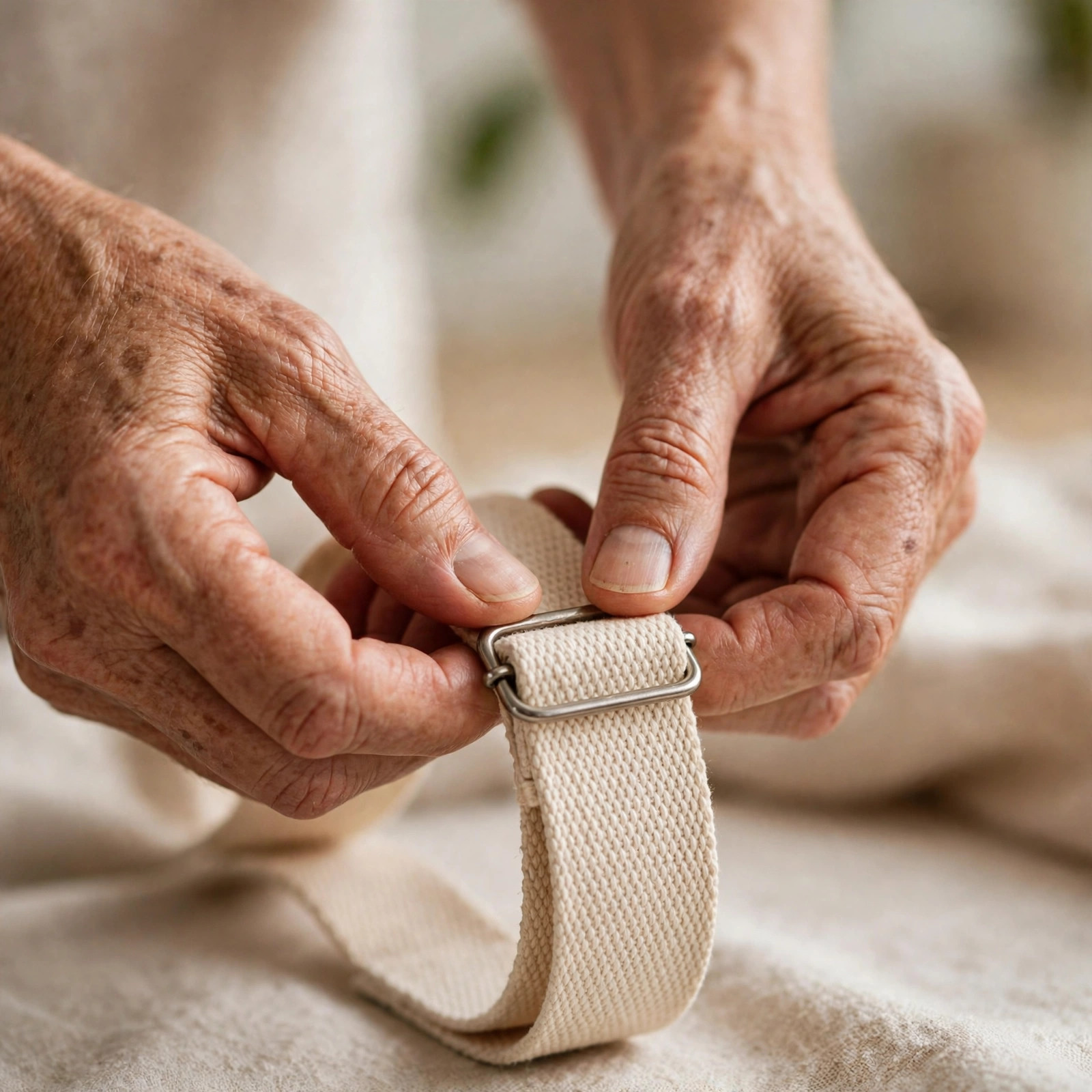
Material and buckles. Cotton straps are soft and easy to grip — a good choice for most seniors. Nylon is stronger and slides more easily through a buckle, but can feel slippery. For stiff or arthritic hands, buckle ease matters most: a D-ring buckle — two metal rings you thread the strap through — is simple and easy to adjust with limited grip strength. A cinch buckle works like a belt buckle but its release button can be fiddly, and plastic quick-release buckles that need a strong squeeze are best avoided. Check that you can open and close the buckle comfortably with your own hands before you buy.
Using blocks and straps for balance and reach
Move slowly, breathe normally, and stop well before anything hurts — a stretch should feel like a gentle pull, never a sharp pain.
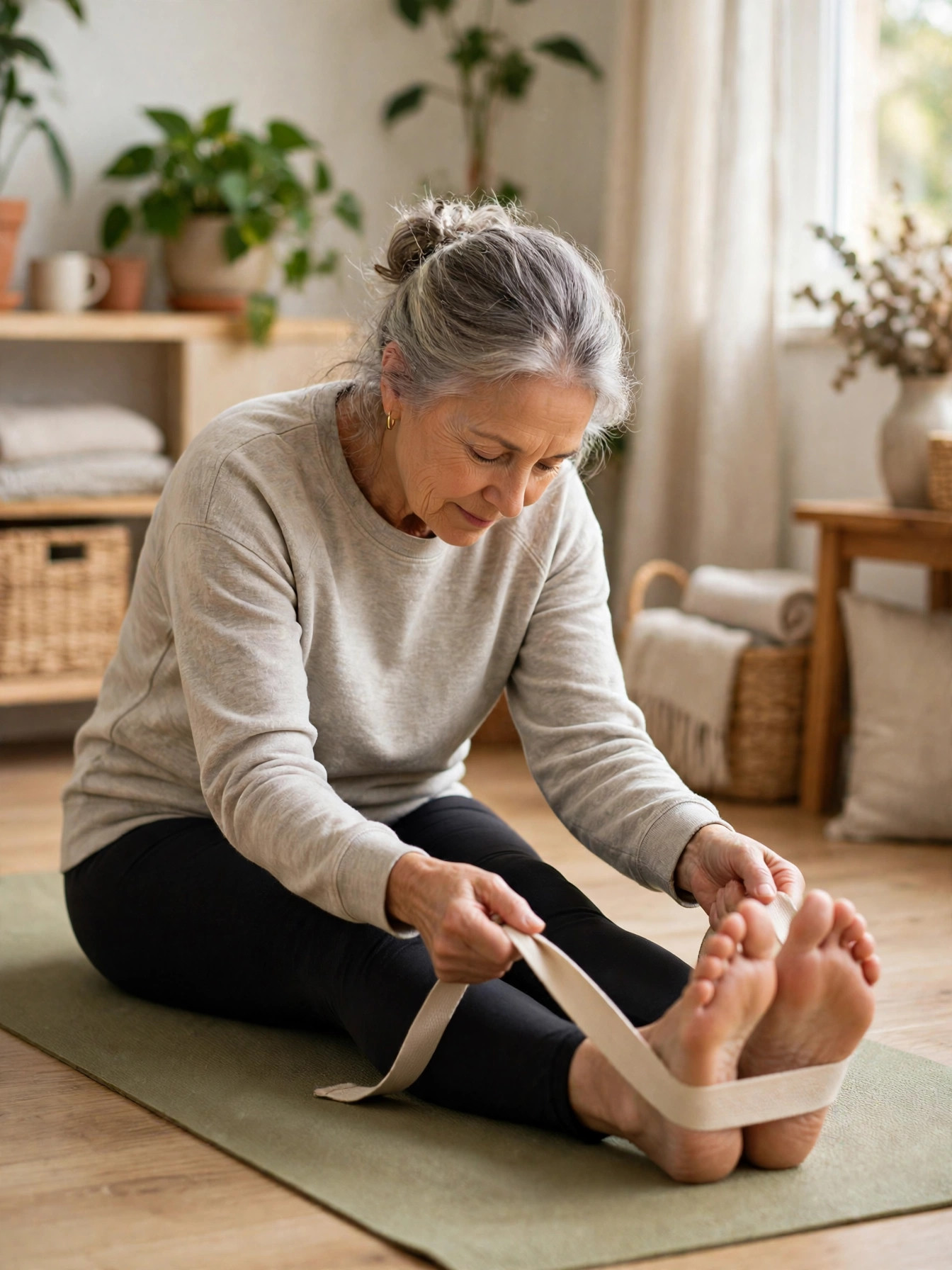
1. Seated forward fold, with a strap. Sit on the floor with legs straight out, or on a chair edge if the floor is hard to reach. Loop the strap around the balls of your feet, hold the ends with both hands, sit tall, then hinge forward from the hips only as far as you comfortably can, letting the strap do the reaching. Hold for five slow breaths. See our 15-minute chair exercise routine if you prefer to stay seated.
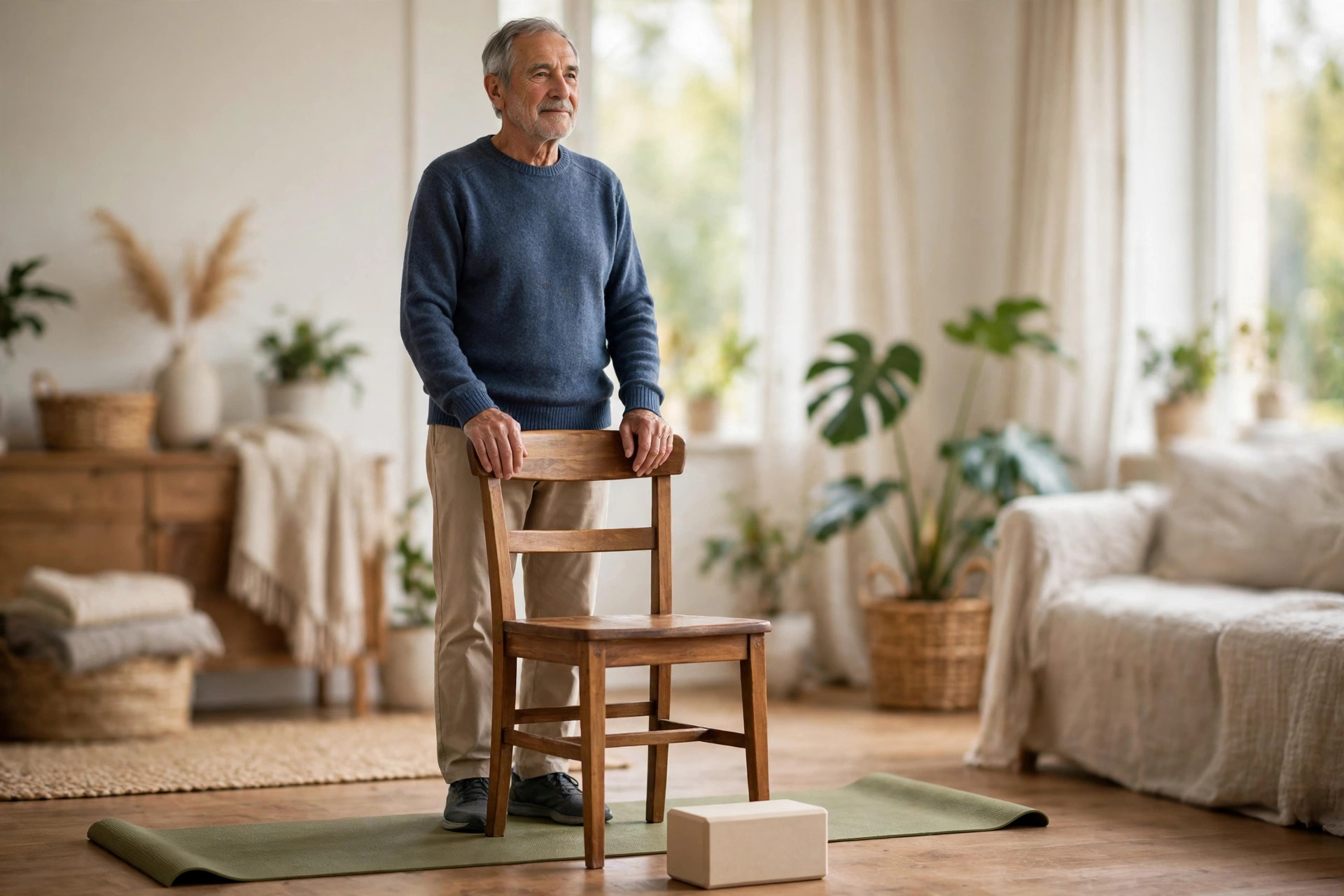
2. Standing side stretch, with a block. Stand beside a sturdy chair, one hand resting lightly on its back. Place a block on its tallest setting just outside your other foot. Reach your free arm overhead and lean gently toward the block, letting your hand rest on it. The block catches your hand, and the chair catches you if anything wobbles. Repeat on the other side.
3. Supported bridge, with a block. Lie on your back with knees bent and feet flat, a block under your lower back at its lowest height. The spine rests in a gentle arch without muscular effort while the block holds the position. Stay for a minute or two, breathing easily, then roll to your side to come out.
4. Chair-assisted balance, with a block. Stand behind a chair with both hands on its back, a block on the floor a step in front of you. Slowly shift your weight onto one foot and reach the opposite hand toward the block, just touching it, then return to standing. It pairs well with our balance exercises to prevent falls guide.
Buying checklist: what to look for, what to avoid
Look for: high-density foam (or cork, if stability is your priority) that springs back when pressed; a pair, not a single block; bevelled edges and a non-slip, textured surface; and an 8-foot cotton strap with a D-ring buckle you can open easily with your own hands.
Avoid: cheap, soft foam that squashes flat under your hand; single blocks without a matching partner; wooden blocks; straps shorter than 6 feet; and buckles that need a strong squeeze or a fiddly release. A solid pair of foam blocks and one good 8-foot strap covers nearly everything a gentle home practice needs.
Safety tips for 45+
Props make yoga safer, but they are not a substitute for common sense. Start at the highest block setting and lower it only when you feel stable and flexible enough. Keep a sturdy, non-wheeled chair nearby for balance. Never force a stretch: a gentle pull is fine; sharp pain is a stop sign. Move slowly between poses — most falls happen in transitions. Practice on a non-slip surface, away from rugs that slide, and do not stack blocks unless they are designed to interlock; if you need more height, use a taller block or a folded blanket. Practice when alert and rested. A short, steady session beats a long, wobbly one.
When to see a doctor
Yoga props are for general fitness, not treatment. Talk to your clinician before starting a new exercise program — and stop and seek advice promptly — if any of the following apply: you have osteoporosis, a joint replacement, or a recent fracture; you have balance problems, dizziness, or a history of falls; you have a heart condition, high blood pressure, or take blood thinners; you feel chest pain, unusual breathlessness, or sudden weakness during exercise; you have new or worsening numbness, tingling, or weakness in your hands or feet; or you have had recent surgery or are recovering from an injury.
The bottom line
The best yoga blocks for seniors are the ones you will actually use: light enough to move without thinking, firm enough to trust your weight to, and tall enough to meet you where your body is today. For most people over 60, that means high-density foam blocks and an 8-foot cotton strap with a D-ring buckle. Cork is the upgrade for maximum stability in standing poses; wood is a skip. Let the block and strap do the reaching so your joints do not have to. A gentler practice is not a lesser practice — it is the one that keeps you coming back.
Sources
- National Center for Complementary and Integrative Health (NCCIH), “Yoga: Effectiveness and Safety” — https://www.nccih.nih.gov/health/yoga-what-you-need-to-know
- Mayo Clinic, “Yoga: Fight stress and find serenity” — https://www.mayoclinic.org/healthy-lifestyle/stress-management/in-depth/yoga/art-20044733
- NHS, “A guide to yoga” — https://www.nhs.uk/live-well/exercise/guide-to-yoga/
- Harvard Health Publishing, “Yoga benefits beyond the mat” — https://www.health.harvard.edu/staying-healthy/yoga-benefits-beyond-the-mat
- National Institute on Aging, “Four Types of Exercise Can Improve Your Health and Physical Ability” — https://www.nia.nih.gov/health/exercise-and-physical-activity/four-types-exercise-can-improve-your-health-and-physical
This article is for general information only and is not medical advice. Talk to your clinician before starting a new exercise program, especially if you have osteoporosis, joint replacements, balance problems, or a heart condition.