Best Knives for Seniors: Lightweight, Easy-Grip Knives
A good knife should feel like an extension of your hand. But if your grip is not what it used to be, the heavy chef’s knife you have owned for twenty years can start to feel like a liability — tiring to hold, hard to control, and a little frightening when it slips.
Disclosure: As an Amazon Associate, we earn from qualifying purchases.
You are not alone in this. Osteoarthritis, the most common type of arthritis, affects about 33 million U.S. adults, according to the Centers for Disease Control and Prevention (CDC), and it most commonly affects the hands, hips, back, and knees. It is common among adults 45 and older, and it can cause pain, stiffness, and swelling in the affected joints. In the hands, that often means a weaker grip and less comfortable control of everyday tools — including kitchen knives.
The encouraging news is that you do not need to give up cooking the food you love. A knife designed for comfort — lighter, better balanced, with a handle that fills the palm — can make chopping, slicing, and dicing feel manageable again. This guide explains what to look for, which knife types are worth considering, and how to use and store them safely. It gives no prices, and the one product shown is an optional example, not a requirement.
Why ordinary knives get harder with age
Three changes explain why.
Grip strength declines. Research from the Framingham Study found that older adults with symptomatic hand osteoarthritis had about 10% lower maximal grip strength than those without it, and reported more difficulty with everyday handling tasks.
Joints get stiff and sore. The CDC notes that osteoarthritis can cause stiffness after resting a joint, less ability to move the joint, and a feeling that the joint is loose or unstable.
Nerve problems can add to the trouble. Carpal tunnel syndrome, caused by pressure on the median nerve in the wrist, is one of the most common hand conditions, according to the Mayo Clinic. Its symptoms can include numbness, tingling, and weakness in the fingers and hand, and people affected by it may drop objects.
A lighter knife with a comfortable handle asks less of your hands — and that smaller demand can be the difference between cooking dinner and ordering takeout.
What to look for in an easy-grip knife
Judge a knife by how it feels in your hand. If you can, hold one before you buy it — a few seconds in your palm tells you more than any product description.
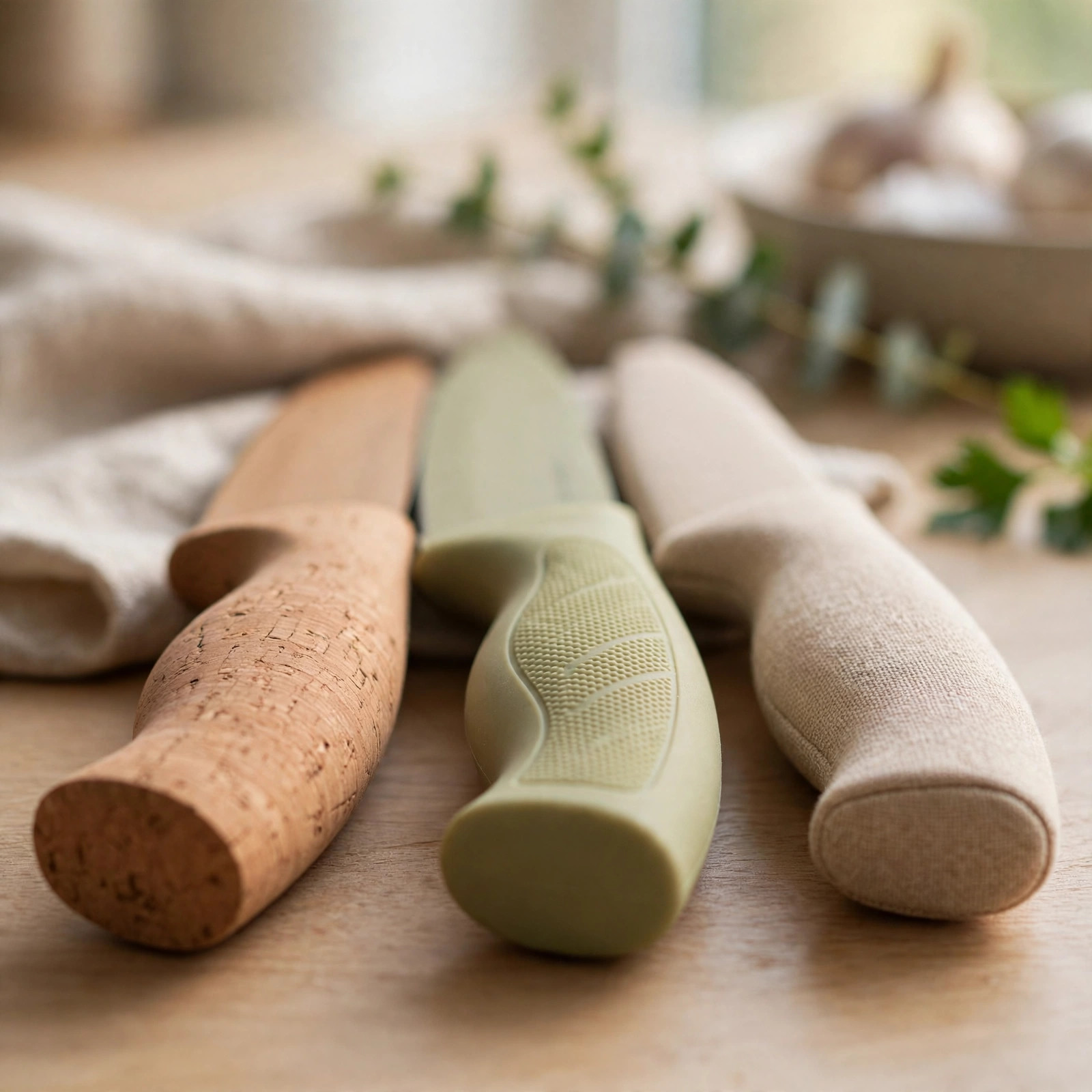
1. Weight: lighter is usually better
A heavy, full-tang chef’s knife can weigh 250 grams or more. For many older cooks, a knife of roughly 100–180 grams feels far easier to control over a full meal’s prep. Lighter does not mean flimsy — sharpness matters more than heft. If a knife makes your wrist ache after a minute of chopping, it is too heavy for you, whatever the label says.
2. Handle shape and material: wide, soft, and shaped to the palm
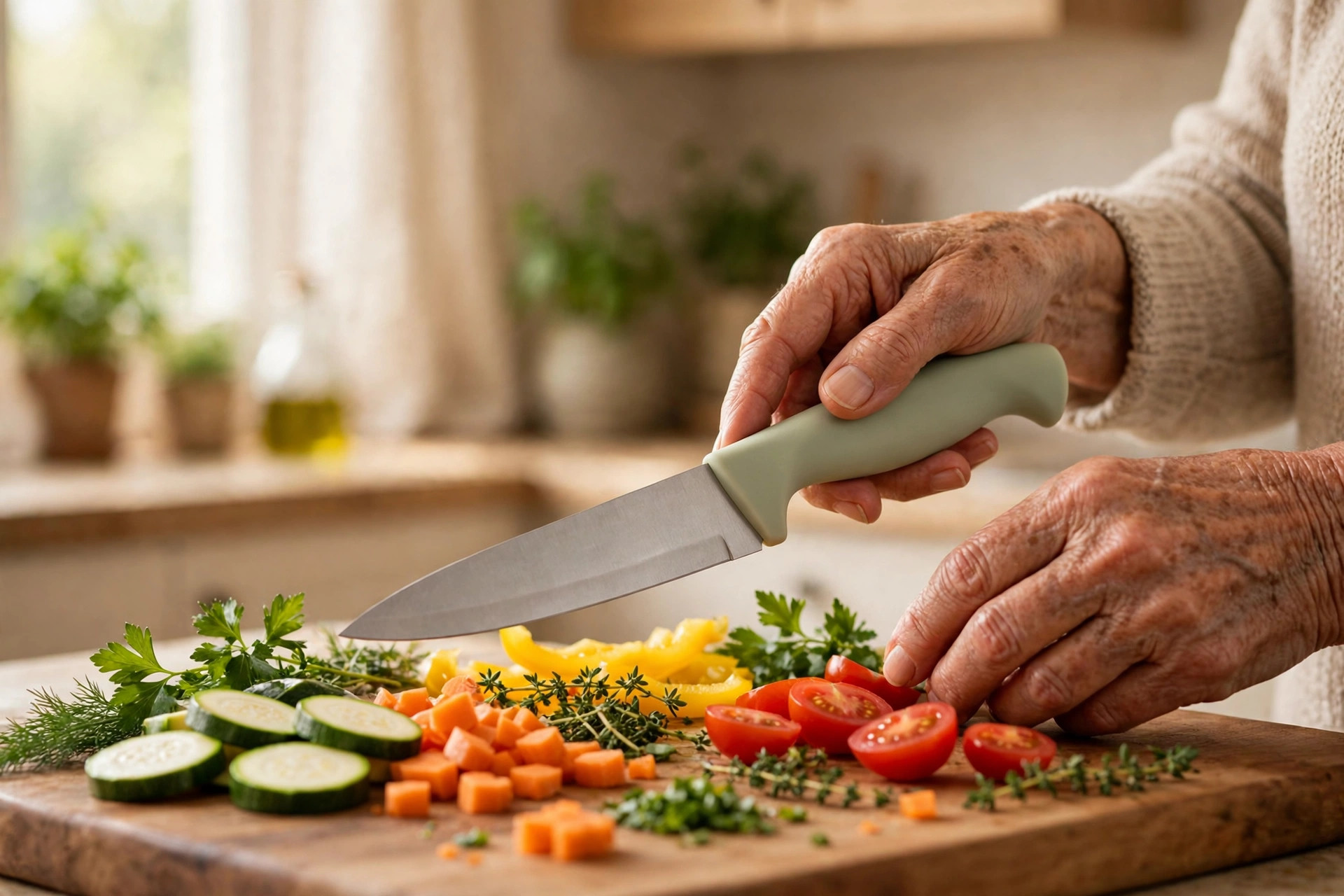
This is the single most important feature for weaker hands. Look for a wide, rounded handle that fills your palm, rather than a thin, flat one you have to squeeze hard to hold. Soft, non-slip materials — rubber, silicone, or textured synthetics — are often kinder than smooth hardwood or polished metal, especially if your hands are damp or a little stiff. A contoured shape that keeps your wrist in a more neutral position may also help. Avoid handles that are slick, very narrow, or hard and unyielding.
3. Blade type: sharp, thin, and the right length
A sharp blade is a safer blade, because it cuts with light pressure instead of force. Look for a blade that is thin behind the edge and easy to keep sharp. A shorter blade — around 15–20 cm (6–8 inches) for a chef’s knife or santoku — is usually easier to control than a long, heavy 25 cm blade, and it is plenty for most home cooking.
4. Balance: the knife should feel level in your hand
Hold the knife at the bolster, where blade meets handle. A well-balanced knife should feel roughly level, not tipping toward the blade or the handle. Trust what feels steady in your hand.
5. Safety features worth having
Look for a finger guard or bolster that helps stop your fingers sliding forward onto the blade, a blade cover or sheath for safe storage and carrying the knife to the sink, and a non-slip handle — a knife that stays put in a damp hand is a safer knife.
Knife types worth considering
You do not need a drawer full of knives. For most home cooks, two or three well-chosen ones cover nearly everything.
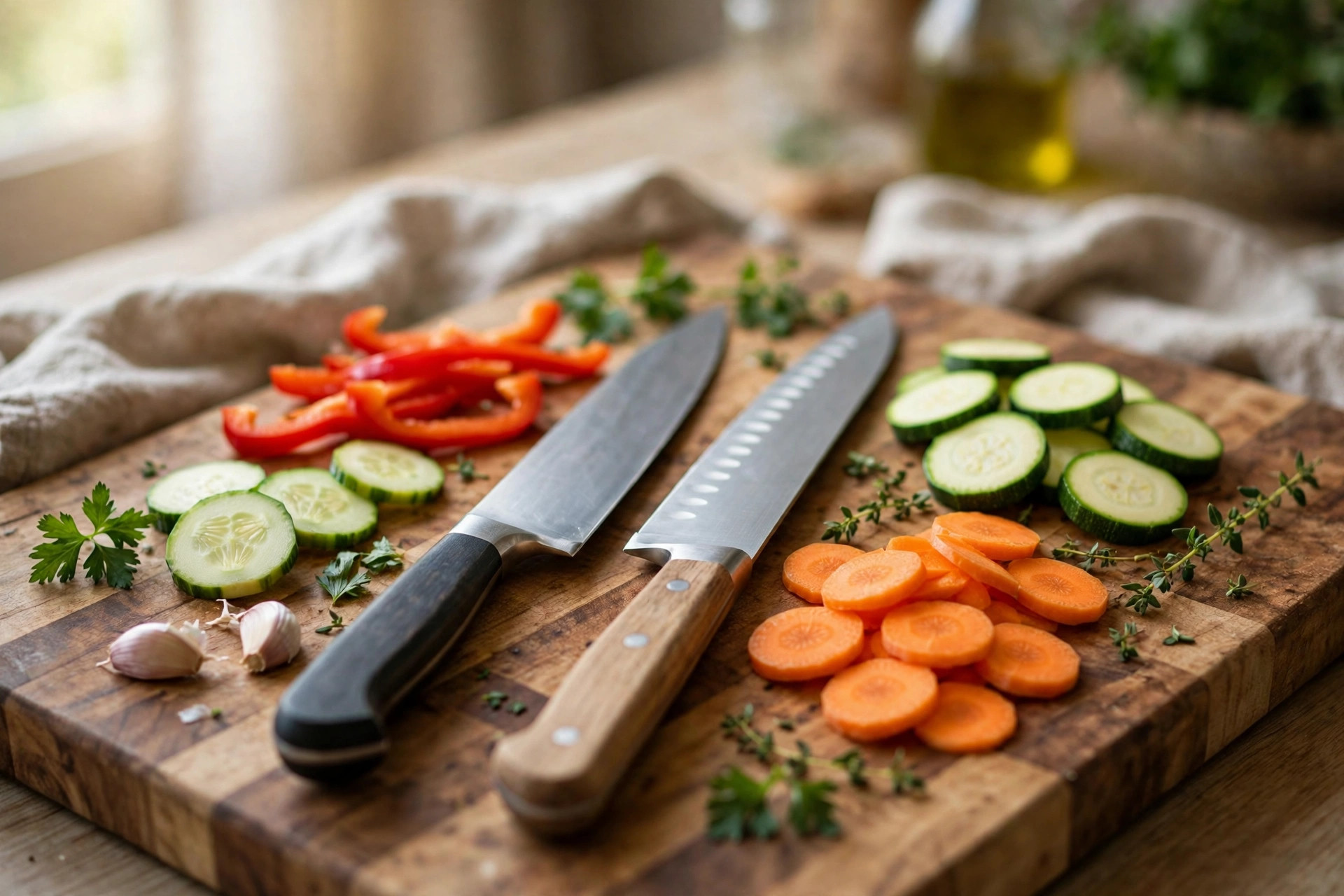
Chef’s knife (15–20 cm / 6–8 inches). The workhorse. A lighter chef’s knife with a wide, soft handle is the single best upgrade for most people. Choose the shorter end of the range if a full-size chef’s knife feels unwieldy.
Santoku knife. Originally from Japan, the santoku has a shorter, wider blade with a flatter edge and often small hollows along the blade that may help food release from the steel. Many older cooks find it easier to control because it is lighter and shorter, and it uses a straight up-and-down chopping motion rather than a rocking one — gentler on sore wrists.
Serrated knife. A serrated edge saws rather than pushes through food, so it suits bread, tomatoes, and other foods with a tough skin and soft inside — and it needs less downward pressure, which may help a weak grip.
Paring knife. A small knife (around 8–10 cm / 3–4 inches) for peeling, trimming, and detail work. Because it is light and short, it is often the easiest knife to control. A paring knife with a thick, comfortable handle is a good companion to a larger knife.
One example worth a look if you want a light, easy-grip chef’s knife:

Victorinox Fibrox Pro Chef’s Knife 8” – The Safest Upgrade You Can Make
The knife upgrade chefs recommend – stays sharp, feels safe in hand.
Safety tips for cooks over 45
A comfortable knife still demands respect. These habits reduce the risk of cuts and make cooking less tiring.
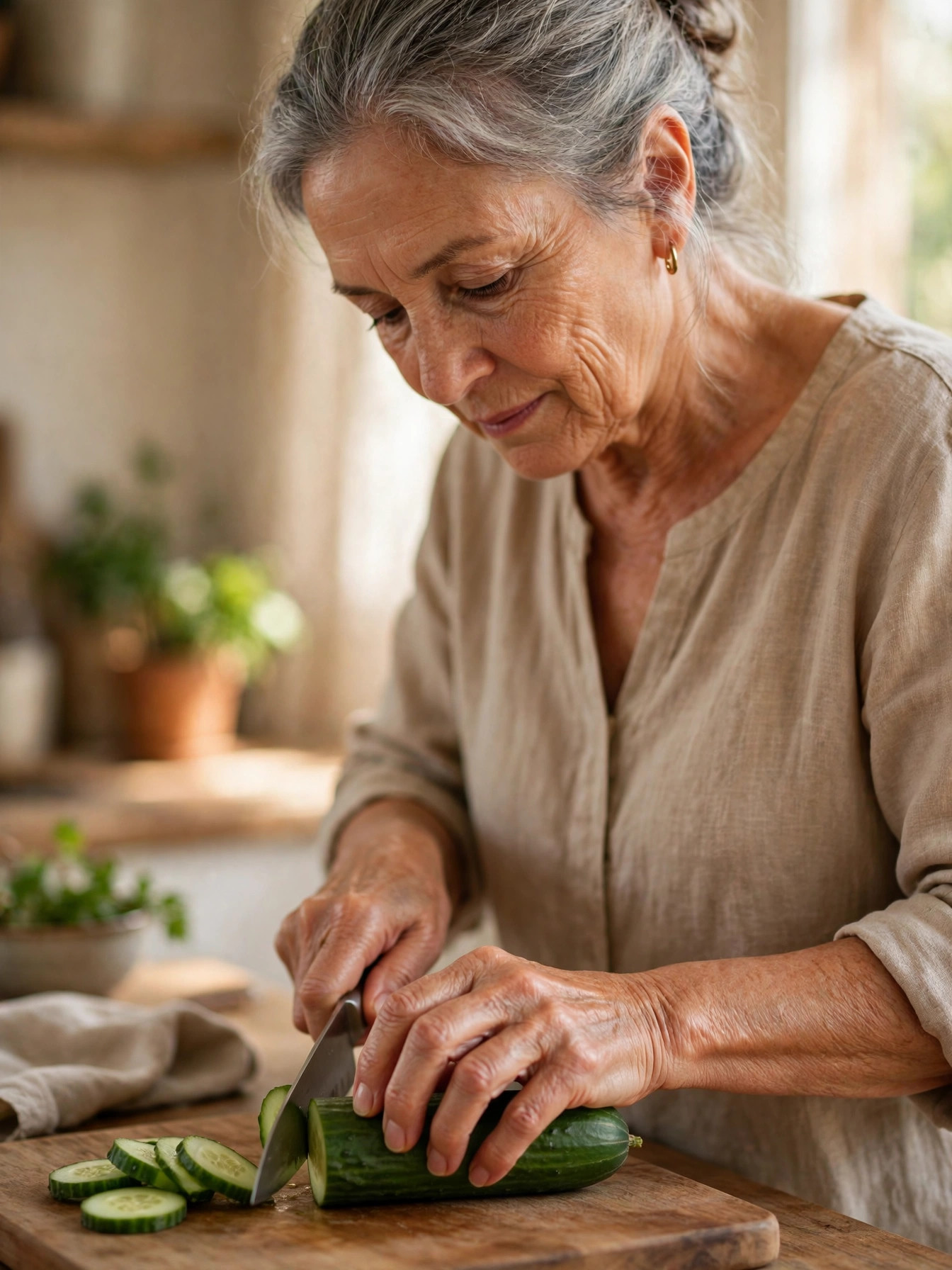
Keep the blade sharp. A dull knife is more dangerous than a sharp one, because it needs more force and is more likely to slip. If a knife crushes a tomato instead of slicing it, it needs sharpening.
Use the claw grip. Curl the fingertips of your guiding hand under, like a claw, so your knuckles — not your fingertips — guide the blade. Keep the flat side of the blade lightly against your knuckles as you cut.
Cut on a stable surface. Place a damp cloth or a non-slip mat under your cutting board so it cannot slide. A board that moves is a common cause of slips.
Let the knife do the work. Press down gently and let the edge cut, rather than forcing the blade through food.
Cut away from your body, and never catch a falling knife. If a knife slips, step back and let it fall. Trying to catch it is how many kitchen cuts happen.
Take breaks. If your hands ache, stop, rest, and stretch your fingers for a minute.
Storage: keep blades safe and easy to reach
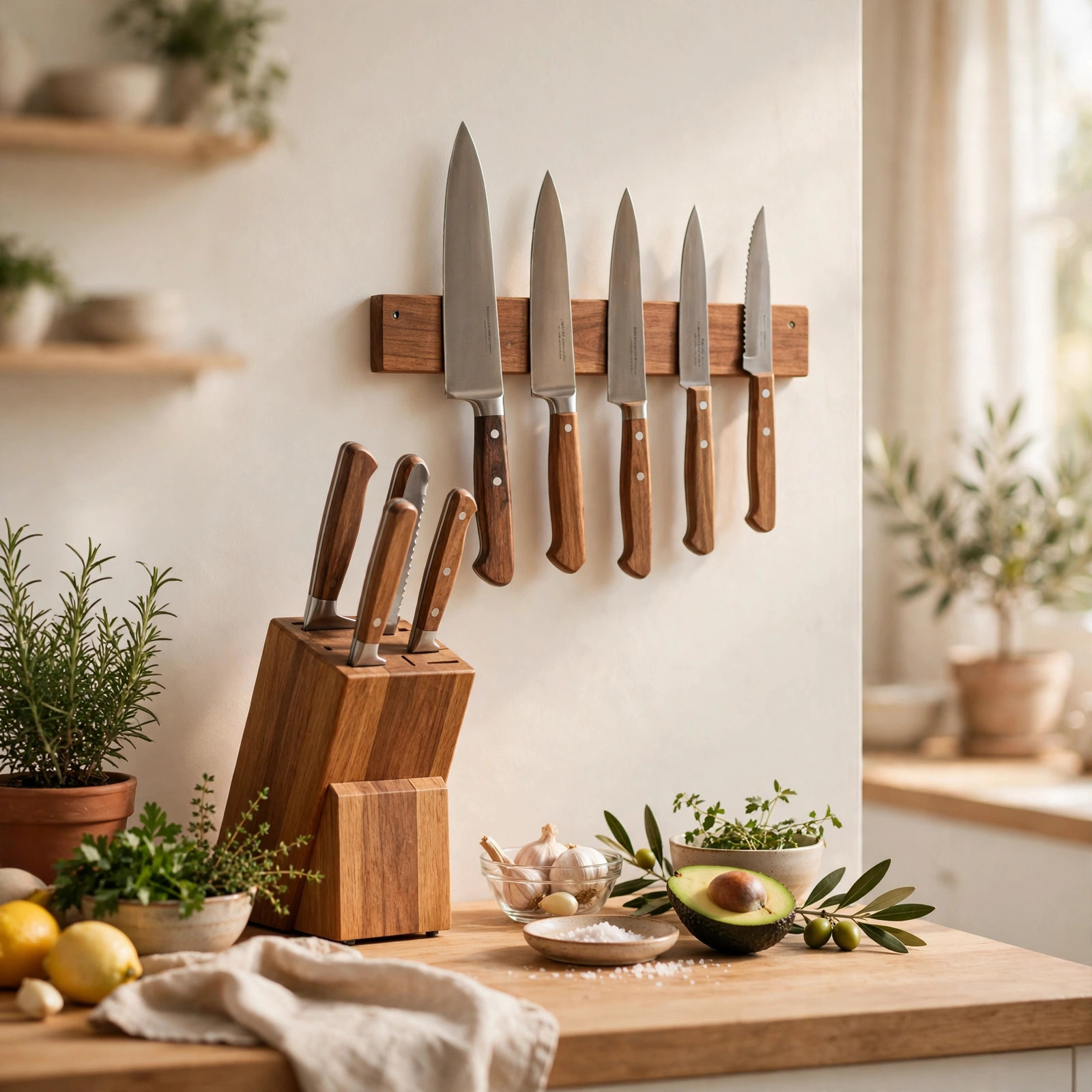
A knife block or magnetic strip keeps blades covered and within easy reach, so you are not digging through a drawer. Blade guards or sheaths protect the edge and your fingers if you do store knives in a drawer. Never store knives loose in a drawer — reaching in blind for a loose blade is a common cause of cuts, and loose blades dull each other. And keep knives out of the sink: a blade hidden under soapy water is a hazard for whoever reaches in. Wash knives promptly by hand, dry them, and put them away.
Care and sharpening basics
Wash by hand with warm, soapy water and dry immediately — dishwashers can dull blades and loosen handles. A honing steel realigns the edge between sharpenings; a few light strokes before cooking can help a knife feel sharper. True sharpening is needed less often, perhaps a few times a year for a home cook — a professional sharpening service is inexpensive and worth it if you are unsure. Store the knife dry. And replace a knife that no longer feels safe: if the handle is cracked, loose, or slippery, or the blade is chipped, retire it.
When to see a doctor
A new knife can make cooking easier, but it cannot fix a hand problem that needs medical attention. See a doctor if you notice:
- Hand pain, stiffness, or swelling that lasts more than a few weeks or keeps getting worse
- Numbness or tingling in your fingers or hand that interferes with daily tasks or wakes you at night — the Mayo Clinic notes that lasting nerve and muscle damage can occur if carpal tunnel syndrome goes untreated
- Weakness in your hands, such as dropping objects often or being unable to grip things you used to hold easily
- A finger or thumb joint that looks deformed, locks, or catches
- Sudden numbness or weakness in a hand or arm, especially with confusion, trouble speaking, or a sudden severe headache — seek emergency care right away, as the Mayo Clinic advises for sudden numbness with these symptoms
The CDC also notes that exercises strengthening the muscles around affected joints may help manage osteoarthritis symptoms — but check with your doctor or a physical therapist before starting a new hand-exercise routine.
The bottom line
The best knife for an older cook is not the most expensive or the most impressive-looking one. It is the lightest, most comfortable knife that still cuts well — a blade that feels balanced in your hand, a handle that fills your palm without demanding a hard squeeze, and an edge you can keep sharp. Start with one good chef’s knife or santoku in a shorter length, add a serrated knife and a paring knife if you need them, and pair them with a stable board, a sharp edge, and unhurried technique.
Sources
- Centers for Disease Control and Prevention, “Osteoarthritis” — https://www.cdc.gov/arthritis/osteoarthritis/index.html
- Zhang Y. et al., “Prevalence of symptomatic hand osteoarthritis and its impact on functional status among the elderly: The Framingham Study,” American Journal of Epidemiology, 2002 — https://pubmed.ncbi.nlm.nih.gov/12446258/
- Mayo Clinic, “Carpal tunnel syndrome: Symptoms and causes” — https://www.mayoclinic.org/diseases-conditions/carpal-tunnel-syndrome/symptoms-causes/syc-20355603
- Mayo Clinic, “Numbness: When to see a doctor” — https://www.mayoclinic.org/symptoms/numbness/basics/when-to-see-doctor/sym-20050938
- National Institute on Aging, “Arthritis and Older Adults” — https://www.nia.nih.gov/health/arthritis/arthritis-and-older-adults
- NHS, “Osteoarthritis” — https://www.nhs.uk/conditions/osteoarthritis/
This article is for general information only and is not medical advice. Talk to your doctor before making changes to your diet, exercise routine, or treatment plan, especially if you have a medical condition or take regular medication.