Elderberry for Immune Support After 50: What the Evidence Says
Few supplements get as much cold-and-flu-season attention as elderberry. The deep-purple berry behind countless syrups, gummies, and teas is sold as a natural way to support your immune system — and after 50, when flu season feels like a higher-stakes affair, the pitch is hard to ignore.
But what does the evidence actually say? Elderberry research turns out to be a case study in how a small number of small trials get stretched into big marketing claims. Here is the honest picture: the real trials, their limitations, the dosing trap most shoppers fall into, and the safety issues that matter most after 50.
What Is Elderberry, Exactly?
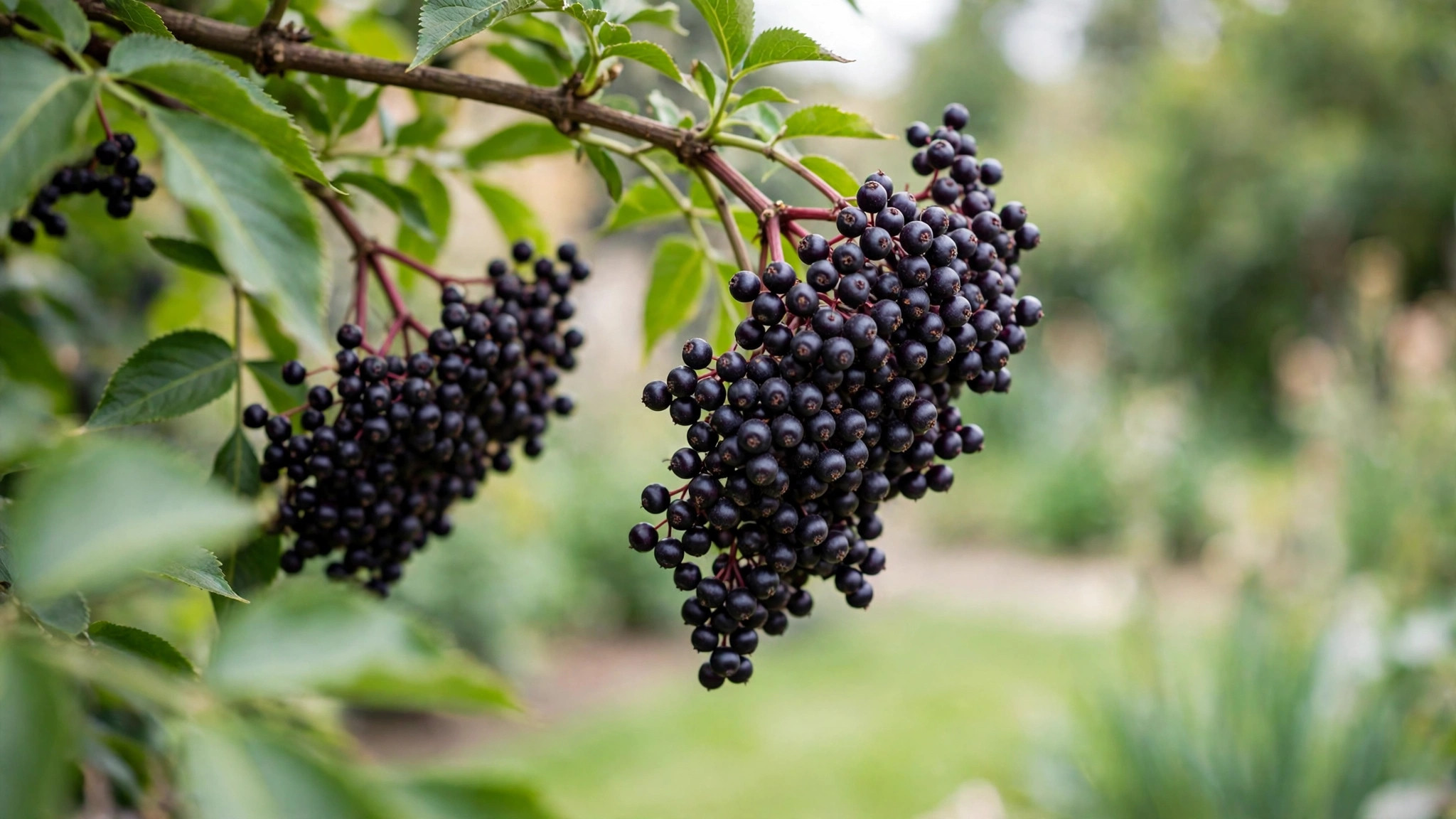
Elderberry is the dark purple fruit of the European black elder tree (Sambucus nigra), native to Europe, North America, Western Asia, and North Africa, according to the U.S. National Center for Complementary and Integrative Health (NCCIH). It has a long history in folk medicine as a remedy for colds and flu, and modern supplement makers have built an industry on that tradition.
The berries are rich in anthocyanins, the pigments behind their deep color and the compounds thought to underlie any biological activity. Laboratory studies show elderberry extracts have antiviral activity against some respiratory viruses in cell cultures — but lab results are not human results, and the honest conversation starts with what happened when researchers gave elderberry to actual people.
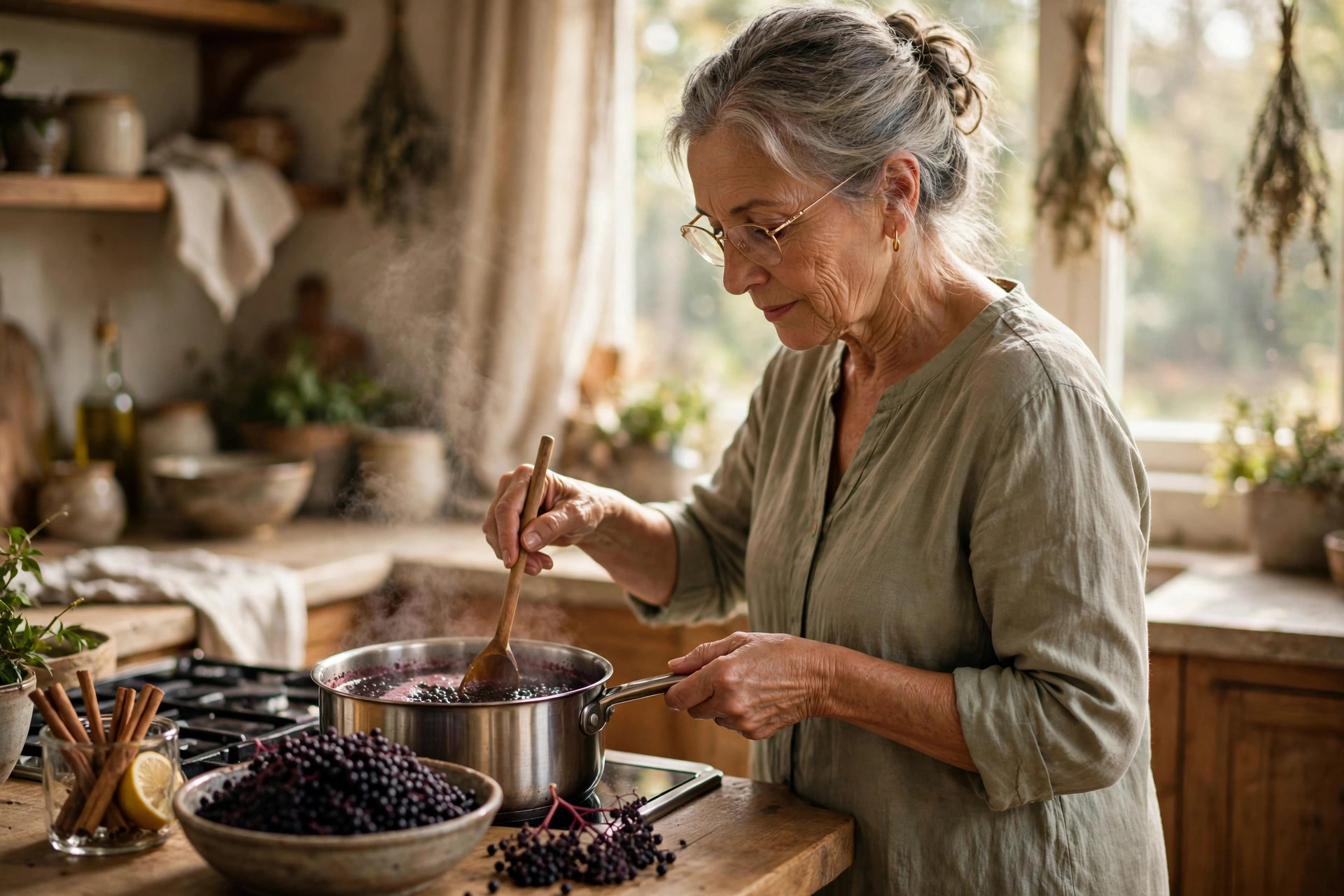
One safety fact before anything else: raw or unripe elderberries — and the plant’s leaves and stems — contain poisonous cyanide-producing substances that can cause nausea, vomiting, and severe diarrhea, per NCCIH. Cooking eliminates the toxin. That is why you should buy properly prepared commercial products rather than foraging your own.
What the Research Actually Shows
Here is the complete, unsweetened picture of the human trials. There are not many of them, and none is large.
The two flu trials. The most-cited studies come from researcher Z. Zakay-Rones and colleagues. The first, published in 1995, was a small double-blind trial run during an influenza B outbreak in Panama: adults took four tablespoons of standardized elderberry syrup (Sambucol) daily for three days. Roughly 93% of the elderberry group showed significant improvement within two days, versus about 92% of the placebo group reaching the same point only after six days. Promising — but only 23 participants were analyzed, and 13 of the 40 originally enrolled were disqualified before analysis.
The second, published in 2004, enrolled 60 patients aged 18 to 54 with flu-like symptoms for 48 hours or less during Norway’s flu season. Patients took 15 ml of elderberry syrup four times daily for five days; symptoms were relieved on average about four days earlier than with placebo, with significantly less use of rescue medication. But the authors themselves wrote that the findings need confirmation in a larger study, and the trial was sponsored by the syrup’s manufacturer.
The air-travel cold trial. The largest trial to date enrolled 312 economy-class passengers flying from Australia overseas. Published in Nutrients in 2016, participants took 600 mg per day of a standardized, membrane-filtered elderberry extract for 10 days before travel, then 900 mg per day during and after the trip. Travelers who caught colds felt ill for an average of 4.75 days versus 6.88 days on placebo, with less severe symptoms. But the trial found no significant reduction in the number of colds — 12 versus 17 — and it was funded by the extract’s maker.
The meta-analysis. A 2019 meta-analysis pooled four controlled trials and concluded elderberry substantially reduced the duration and severity of upper respiratory symptoms. Encouraging — but four trials using different extracts and doses is a thin foundation.
Older adults specifically. In 2020, researchers gave 60 nursing-home residents over age 65 a daily sachet of elderberry plus reishi mushroom extract for 14 weeks. The combination reduced the duration and severity of respiratory infections — but not how many infections occurred, and a combination product cannot tell us what elderberry alone would do.
How NCCIH summarizes it. The National Center for Complementary and Integrative Health puts it plainly: “Some preliminary research suggests that elderberry may relieve symptoms of flu, colds, or other upper respiratory infections.” A 2020 review it cites found only hypothetical benefit, with insufficient conclusive evidence from high-quality clinical trials.
The honest verdict: there is real, if modest, evidence that elderberry may shorten flu and cold symptoms when started early — roughly one to four days sooner depending on the trial. There is no good evidence it prevents colds or flu, or that year-round daily “immune support” dosing works. Nearly all the research is about treatment, not prevention. And one gap matters to this site’s readers: none of the flu trials specifically studied adults over 50 — the 2004 trial enrolled ages 18 to 54. We are extrapolating from younger adults.
The Gummy-Underdosing Trap
The trial doses were substantial: 600 to 900 mg per day of a standardized extract for weeks (the travel trial), or 15 ml of syrup four times daily for five days (the flu trials).
Now look at the typical elderberry gummy. A survey of product labels in the NIH Dietary Supplement Label Database found the most common elderberry amount per serving is just 100 mg, with typical gummies in the 50 to 150 mg range — roughly one-tenth of what the travel trial tested.
The product most people buy bears little resemblance to the products tested in the trials behind all the claims. Trials used defined standardized extracts, while many gummies list only “elderberry fruit powder,” which says almost nothing about potency. There is no reason to assume a low-dose gummy will reproduce trial results. If you try elderberry, the trial data applies best to syrups or capsules stating a meaningful amount of standardized extract.
How to Read an Elderberry Label
Shopping for elderberry after reading the trial data changes what you look for:
- Milligrams of standardized extract. Look for a stated amount, ideally with anthocyanin content. “Elderberry 5:1 extract” means something; “elderberry fruit powder” means very little.
- Total daily dose near the trial range — roughly 600 to 900 mg of extract per day. A 100-mg-per-serving gummy would take far more than the label suggests.
- Third-party testing. USP or NSF seals mean the bottle contains what the label claims.
- Added sugar and timing. Many syrups are sweetened; capsules sidestep that. Every positive trial started treatment within 24 to 48 hours of symptoms — elderberry has not been shown to work as a year-round shield.
Forms Compared: Syrup, Capsules, Gummies, and Teas
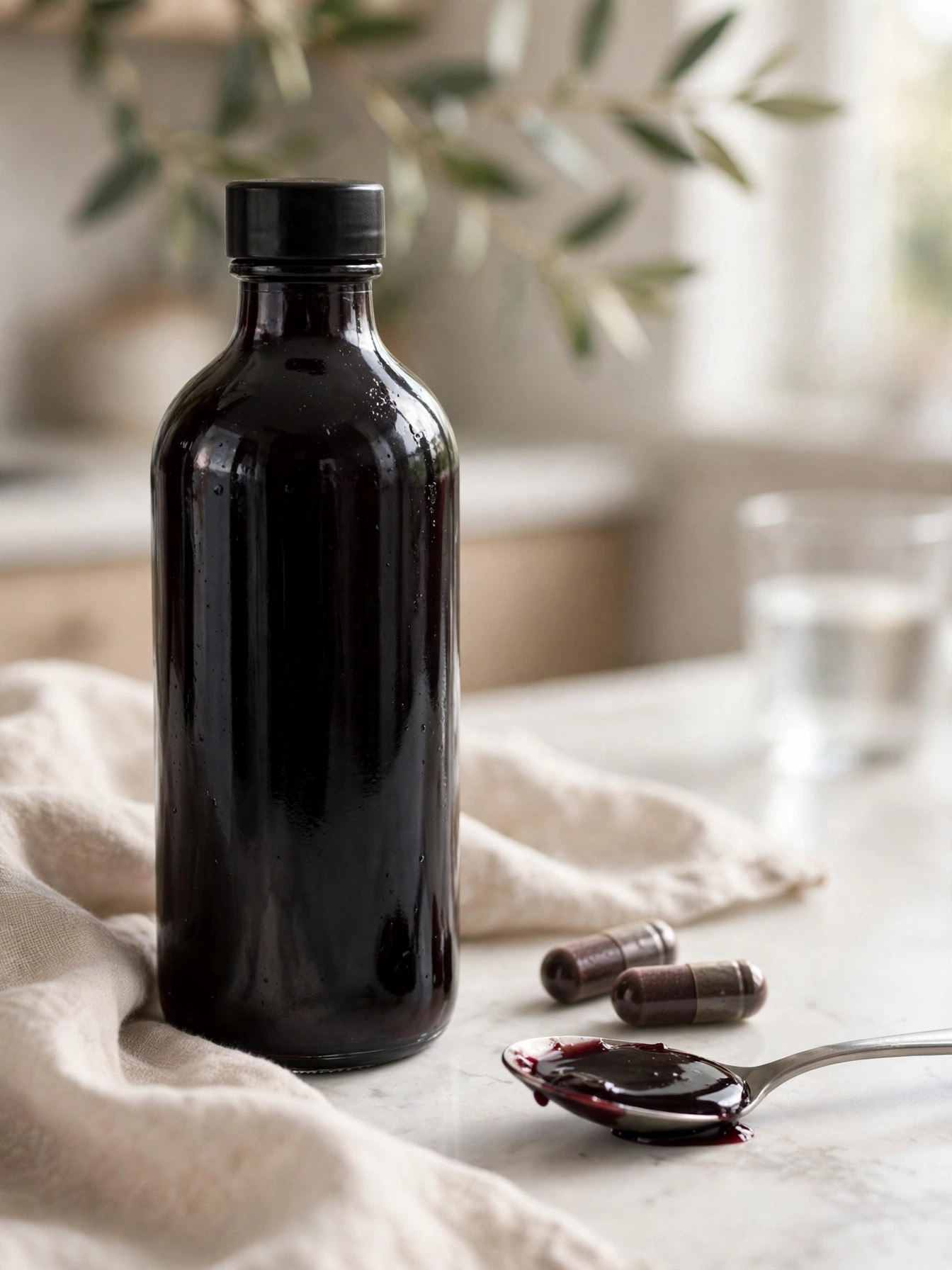
- Syrup. The most studied format — what both flu trials used. Easiest to dose like the research, but usually sweetened and bulky to store.
- Capsules. Concentrated, sugar-free, and the format of the travel trial’s extract. The most practical way to reach higher studied doses.
- Gummies. Convenient and pleasant, but typically the lowest dose per serving and sweetened. The weakest match to the trial evidence.
- Teas and lozenges. Traditional and comforting, but no clinical trials support them for colds or flu.
No form has evidence of preventing illness. And no supplement replaces the flu vaccine.
Safety: What After-50 Shoppers Must Know
Never eat raw or unripe elderberries. The cyanide-producing substances (such as sambunigrin) in uncooked berries, leaves, bark, and stems can cause nausea, vomiting, and severe diarrhea — and large quantities can cause serious illness, per NCCIH. Cooking destroys the toxin. Stick to properly prepared commercial products; do not forage or DIY.
Pregnancy and breastfeeding. NCCIH notes that little is known about safety during pregnancy or breastfeeding, so elderberry is best avoided in those situations.
Who should check with a doctor first:
- Autoimmune conditions. Elderberry may influence immune activity, so people with rheumatoid arthritis, lupus, multiple sclerosis, or similar conditions should get medical guidance first.
- Diabetes medication or insulin. Elderberry may potentiate glucose-lowering drugs, raising the risk of low blood sugar.
- Immunosuppressants or blood pressure drugs. Documented interactions exist with immunosuppressant drugs. NCCIH’s standing advice: if you take any medicine, talk with your health care provider before using elderberry.
- Added sugar. Many syrups are sweetened; check the label if you manage blood sugar.
And the non-negotiable: elderberry does not replace flu vaccination. The CDC recommends annual flu vaccination for everyone over 6 months of age and calls vaccination the best protection against getting the flu. For adults over 65, flu hits harder — if symptoms appear, contact your doctor promptly, because prescription antivirals work best when started early.
When to See a Doctor
Seek medical care promptly if you experience:
- Flu symptoms if you are over 65, have a chronic condition, or are immunocompromised — ask your doctor about prescription antivirals, which work best within the first two days.
- Difficulty breathing, chest pain or pressure, persistent dizziness, confusion, or severe weakness.
- A fever that does not come down, or symptoms that improve and then suddenly worsen.
- Severe vomiting or diarrhea after consuming any homemade elderberry preparation — possible poisoning from raw or unripe berries.
If you take prescription medications — especially for diabetes, blood pressure, or immune suppression — talk with your doctor or pharmacist before adding elderberry to your routine.
The Bottom Line
Elderberry is not a miracle and it is not a scam. The truth sits in between: a handful of small trials suggest it may modestly shorten flu and cold symptoms when started early, but the studies are small, mostly industry-funded, and none focused on adults over 50. There is no good evidence it prevents illness, and most gummies contain a fraction of the doses actually tested.
If you try it, do it with eyes open: choose a standardized extract at a meaningful dose, start it at the first sign of symptoms, buy a properly prepared commercial product, check with your doctor if you take medications — and get your flu shot regardless.
Sources
- National Center for Complementary and Integrative Health (NCCIH). “Elderberry: Usefulness and Safety.” https://www.nccih.nih.gov/health/elderberry
- NCCIH. “The Common Cold and Complementary Health Approaches: What the Science Says.” https://www.nccih.nih.gov/health/providers/digest/the-common-cold-and-complementary-health-approaches-science
- NCCIH. “Colds, Flu, and Complementary Health Approaches.” https://www.nccih.nih.gov/health/colds-flu-and-complementary-health-approaches
- Zakay-Rones Z, Thom E, Wollan T, Wadstein J. “Randomized study of the efficacy and safety of oral elderberry extract in the treatment of influenza A and B virus infections.” J Int Med Res. 2004;32(2):132–140. PMID: 15080016. https://pubmed.ncbi.nlm.nih.gov/15080016/
- Hawkins J, Baker C, Cherry L, Dunne E. “Black elderberry (Sambucus nigra) supplementation effectively treats upper respiratory symptoms: A meta-analysis of randomized, controlled clinical trials.” Complement Ther Med. 2019;42:361–365.
- Tiralongo E, Wee SS, Lea RA. “Elderberry Supplementation Reduces Cold Duration and Symptoms in Air-Travellers: A Randomized, Double-Blind Placebo-Controlled Clinical Trial.” Nutrients. 2016;8(4):182. Summary: https://news.griffith.edu.au/2015/07/21/elderberry-benefits-air-travellers/
This article is for informational purposes only and is not medical advice. Talk to your clinician before making any changes to your health routine.