
Aged Garlic Extract for Blood Pressure After 50: What the Evidence Says
Garlic has been linked to heart health in folk medicine for centuries, and it is one of the few natural products with a real stack of clinical trials behind it. If you have searched for natural ways to manage blood pressure after 50, you have almost certainly seen aged garlic extract — often sold under the Kyolic brand name — promoted as the odorless version that science takes seriously.
The marketing is confident. The evidence deserves a closer look. Here is what the trials actually show, who seems to benefit, and the safety details that matter — especially if you take blood thinners.
What aged garlic extract is — and how it differs from raw garlic
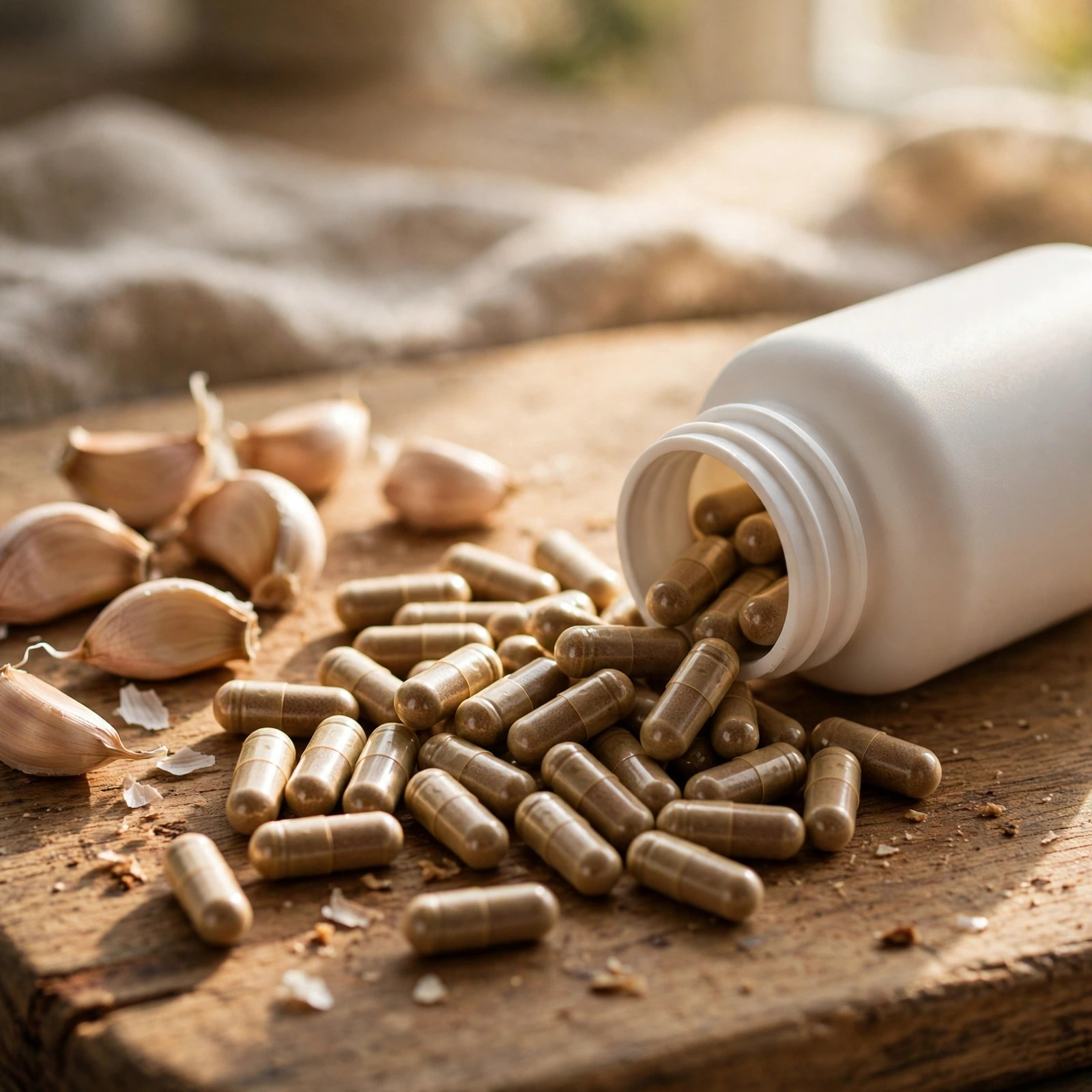
Aged garlic extract (AGE) is not simply dried or powdered garlic. It is made by soaking sliced raw garlic in a mild water-and-ethanol solution at room temperature for up to 20 months, then filtering and concentrating it. During that long aging, the harsh, odorous compounds in raw garlic — including allicin, responsible for its pungent smell and stomach bite — are converted into stable, odorless, water-soluble sulfur compounds, most notably S-allylcysteine (SAC).
That shift matters twice over. SAC is well absorbed by the digestive tract, so the active compounds reach your blood more reliably than the unstable allicin in raw garlic. And the conversion is exactly why aged extract is marketed as “odorless”: the breath and body odor that come with raw garlic are largely gone.
The blood-pressure trials used standardized supplements, not kitchen garlic. A clove or two in your cooking does not deliver the same concentrated, consistent dose — and heat destroys many of the active substances in raw garlic anyway.
What the research actually shows

Researchers at Australia’s National Institute of Integrative Medicine — led by Karin Ried — have published a series of the best-known trials on aged garlic extract and blood pressure, along with updated meta-analyses pooling the available randomized controlled trials.
The most comprehensive review, published in Experimental and Therapeutic Medicine (2020), pooled 12 randomized controlled trials covering 553 participants with hypertension. The result: garlic supplementation lowered systolic blood pressure by an average of about 8.3 mmHg and diastolic by about 5.5 mmHg — an effect the authors described as comparable to first-line standard blood-pressure medications.
An earlier meta-analysis by the same group (2008) found a similar picture: in the hypertensive subgroup, average reductions of roughly 8.4 mmHg systolic and 7.3 mmHg diastolic versus placebo. So “around 5–10 mmHg off the top number” is a fair summary of the pooled trial evidence — with a clear qualifier.
The qualifier: it mainly works in people who already have high blood pressure. Across the reviews, people with normal or borderline readings saw little to no effect. The benefit scales with where you start: the higher your baseline, the larger the typical drop. If your blood pressure is already in a healthy range, there is no evidence that aged garlic extract will push it lower — and no reason to expect it to.
The individual trials behind the numbers
Two of Ried’s own trials illustrate the typical design — and the caveats:
- Uncontrolled hypertension, 2010: 50 adults whose pressure stayed high despite medication took four capsules of aged garlic extract daily (960 mg) or placebo for 12 weeks. The garlic group dropped about 10 mmHg systolic — striking, but from a small study, and everyone stayed on their prescribed medication.
- Dose-response, 2014: 79 patients took 240, 480, or 960 mg daily for 12 weeks. The 480 mg group reduced systolic pressure by about 11.8 mmHg versus placebo, with the best balance of effect and tolerability. The lowest dose showed no significant effect.
Older trials using garlic powder (600–900 mg/day) were more mixed — some showed modest drops, others none — which is why aged extract, with standardized SAC content, now dominates the serious research.
The honest caveat
The U.S. National Center for Complementary and Integrative Health (NCCIH) takes a more cautious line: there is “limited evidence” that garlic supplements may reduce blood pressure “to a small extent” in people with high blood pressure, and evidence is mixed overall. That is the difference between pooling hypertensive-only trials (where the effect looks solid) and surveying all garlic research (where results vary by preparation, dose, and population). Both statements are true; the honest reading is that aged garlic extract is the best-studied preparation and the benefits are real but modest — not a stand-in for proven treatment.
How it compares to other approaches
Lifestyle measures still do the heavy lifting: cutting sodium, losing excess weight, regular moderate exercise, and limiting alcohol typically produce larger and more reliable drops than any supplement. The DASH eating pattern can lower systolic pressure by double digits in people with hypertension.
Aged garlic extract belongs in the “possible modest addition” category — not the “foundation” category. And nothing in the evidence supports stopping or reducing prescribed medication in favor of garlic: in the best trials, participants kept taking their medication; the extract was tested as an add-on, not a replacement. High blood pressure is usually symptomless while it quietly damages arteries, heart, kidneys, and eyes.
How to choose and use it, if you try
If you and your doctor agree it is reasonable to try, here is what the trial evidence suggests:
- Look for “aged garlic extract” standardized for S-allylcysteine (SAC). This is the compound the trials’ doses are based on. Kyolic is the brand used in Ried’s trials, but other products standardized the same way are judged by the same logic — look for SAC content on the label.
- Dose context from the trials: effective doses ranged from about 600 to 1,200 mg of aged extract per day (the well-known trials used 480–960 mg/day). There is no officially established “recommended dose” — these are simply the doses that were studied.
- Give it 8–12 weeks. The trials measured effects over two to three months; aged garlic extract is not a quick fix. Evaluate it with your home blood-pressure log after a few months of consistent use.
- Take it consistently, ideally with food. Mild stomach upset is the most common side effect, and taking capsules with meals usually prevents it.
- Check the label for SAC content. You want aged garlic extract standardized for S-allylcysteine, not a “heart blend” of five ingredients at unknown doses — those cannot be judged against the research.
One more buyer tip: the “odorless” claim genuinely matters for daily use. If a product leaves you burping garlic, it is probably not well-aged extract — that is exactly what the aging process is supposed to eliminate.
Safety and interactions: the part you must not skip

Aged garlic extract is generally considered safe for most adults at studied doses, with side effects limited mostly to mild digestive symptoms. But “natural” does not mean harmless, and garlic’s known effects on blood clotting deserve your full attention.
Blood thinners — especially warfarin. Mayo Clinic lists garlic among the common supplements that can interact with warfarin, increasing bleeding risk. Garlic’s sulfur compounds mildly inhibit platelet aggregation, and combined with a drug designed to slow clotting, the total effect can be too much. If you take warfarin, aspirin, clopidogrel (Plavix), or newer blood thinners, talk to your doctor before adding aged garlic extract — and watch for unusual bruising, nosebleeds that will not stop, or blood in urine or stool.
Before surgery. Because of the clotting effect, most surgical teams advise stopping garlic supplements a week to two weeks before a procedure. Tell your surgeon about all supplements you take.
Low blood pressure and blood-sugar drugs. Anything that may lower blood pressure deserves caution if your pressure is already well controlled or low. Garlic may also modestly reduce blood sugar, so people on diabetes medication should watch their readings when starting it.
None of this rules the extract out for most healthy adults. It simply means garlic belongs in the same category as any active substance: discuss it with your doctor or pharmacist, especially when other medications are involved.
Who it is most — and least — likely to help
To summarize plainly: most likely to benefit are adults over 50 with diagnosed high blood pressure who are already on treatment and lifestyle measures, looking for a possible modest additional reduction under a doctor’s supervision. Unlikely to help much: people with normal blood pressure, or anyone hoping a supplement can replace exercise, a good diet, or prescribed medication. And it should be avoided or used only with explicit medical approval by anyone on blood thinners (especially warfarin), anyone scheduled for surgery, and pregnant women.
When to see a doctor
See your clinician before starting aged garlic extract if you take any prescription medication — particularly blood-pressure drugs, blood thinners, or diabetes drugs — or if you have a bleeding disorder or upcoming surgery.
Seek prompt medical care if you experience severe headache, chest pain, shortness of breath, vision changes, or numbness — no supplement is appropriate for those situations. And if you notice unusual bruising, prolonged bleeding from minor cuts, or blood in your urine or stool after starting garlic, stop the supplement and contact your doctor promptly.
Do not change, reduce, or stop any prescribed blood-pressure medication based on a home monitor reading or how you feel — medication changes must go through your prescribing clinician.
Sources
- National Center for Complementary and Integrative Health (NCCIH), National Institutes of Health — “Garlic: Usefulness and Safety” (limited evidence garlic supplements may reduce blood pressure to a small extent in people with high blood pressure): https://www.nccih.nih.gov/health/garlic
- Agency for Healthcare Research and Quality (AHRQ) Evidence Report Summary via NCBI — “Garlic: Effects on Cardiovascular Risks and Disease” (reviews blood-pressure findings and reported adverse effects including bleeding): https://www.ncbi.nlm.nih.gov/books/NBK11910/
- Ried K. “Effect of aged garlic extract on blood pressure and other cardiovascular markers in hypertensive patients and its relationship with dietary intake” — updated meta-analysis of 12 trials in 553 hypertensive participants, Experimental and Therapeutic Medicine (2020) (average reductions of ~8.3 mmHg systolic and ~5.5 mmHg diastolic; effects compared with first-line standard medications): https://www.researchgate.net/publication/377050031_Effect_of_aged_garlic_extract_on_blood_pressure_and_other_cardiovascular_markers_in_hypertensive_patients_and_its_relationship_with_dietary_intake
- “The Antioxidant Mechanisms Underlying the Aged Garlic Extract- and S-Allylcysteine-Induced Protection” — describes the up-to-20-month aging process and how harsh compounds are converted into stable S-allylcysteine (SAC), via PubMed Central: https://pmc.ncbi.nlm.nih.gov/articles/PMC3363007/
- “Potential Health Benefit of Garlic Based on Human Intervention Studies: A Brief Overview” — trial tables including aged garlic extract (Kyolic) studies in hypertensive and metabolic-syndrome patients, via PubMed Central: https://pmc.ncbi.nlm.nih.gov/articles/PMC7402177/
- Mayo Clinic — warfarin interactions: garlic listed among common supplements that can interact with warfarin (bleeding risk): https://www.mayoclinic.org/diseases-conditions/deep-vein-thrombosis/in-depth/warfarin-side-effects/art-20047592
This article is for informational purposes only and is not medical advice. Talk to your clinician before making any changes to your health routine.